
Tracy reserves his most emphatic language for this final principle. "There is no failure except in no longer trying," he writes. "There is no defeat except from within." Persistence, in his framework, is not a personality trait; it is a skill that is built through practice, deepened by repetition, and made sustainable only when it is anchored to a goal that genuinely matters to you. It is also, he argues, the ultimate determinant of success: everything else being equal, the person who outlasts the most obstacles wins.
The "persistence test" is his name for the moment that precedes most great achievements: the point at which everything inside you says to stop, the evidence for continuing seems thin, and the cost of going on feels greater than the prospect of the reward. Tracy's observation, backed by the stories of virtually every significant achiever he studied, is that this is precisely the moment when success is closest. Most people stop just before it arrives.
Self-Discipline as Character
Tracy's definition of character is spare and demanding: it is the ability to follow through on a resolution after the enthusiasm with which it was made has passed. This is why persistence cannot be built on motivation alone; motivation fluctuates. It has to be built on something more durable: clarity of values, written goals, a daily review practice, and the accumulated experience of having done hard things before and survived them.
Success comes one step beyond failure. Your greatest successes almost invariably come one step beyond the point where everything inside of you says to quit.
Brian Tracy — Goals!This is why persistence cannot be understood in isolation from the other five principles in this series. You cannot persist toward the wrong goal; the fuel runs out. You cannot persist without a daily reminder of what you are working toward. And you cannot persist through fear that has not been faced and walked through. Persistence is the expression of all the other principles under pressure.
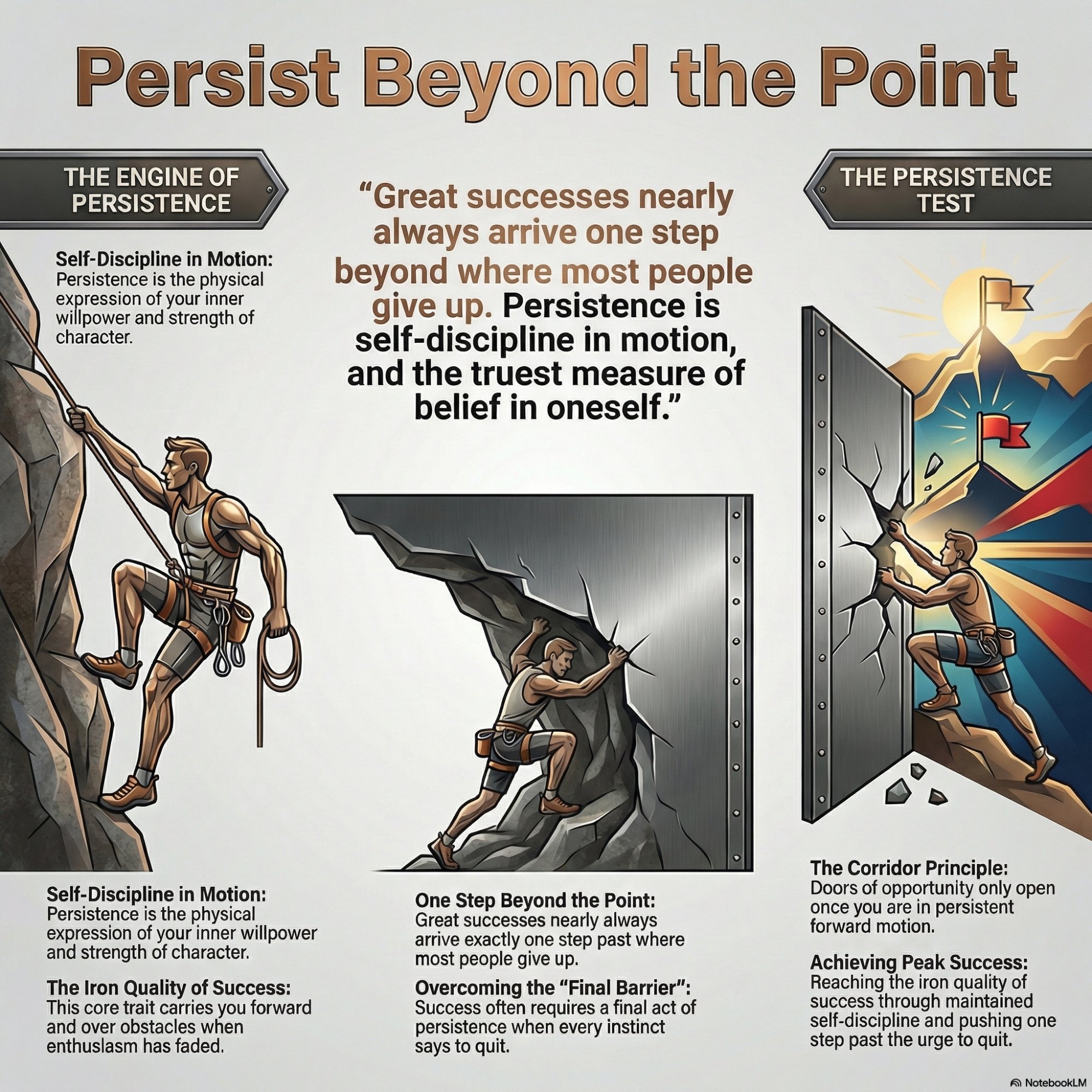
The engine, the test, and the corridor — Tracy's three-part framework for what persistence actually requires and what it opens up. Created with NotebookLM.
Stephen King — Thirty Rejections and a Bin
Stephen King's first novel, Carrie, was rejected by publishers thirty times. After the thirtieth rejection, King threw the manuscript in the bin. His wife Tabitha retrieved it, read it, and told him to keep going. He submitted it to Doubleday, who accepted it. The advance was $2,500. The paperback rights sold for $400,000. King has since sold more than 350 million books.
The distance between the thirtieth rejection and the thirty-first submission is the entire width of Tracy's persistence test. King was not more talented after Tabitha intervened than he was before. The manuscript had not changed. What changed was the decision, made partly by someone who believed in him and partly by his own returning conviction, to submit once more. That single act of continuing was the difference between one of the most successful literary careers in history and a discarded pile of paper.
Tracy writes that successful people fail far more often than unsuccessful people; they try more things and they pick themselves up more times. King's career is a long demonstration of this. He has spoken openly about the number of manuscripts he abandoned, the stories that didn't work, the periods when the writing felt mechanical. He kept writing anyway. The persistence was not directed at a single manuscript. It was a practice, maintained across decades, of returning to the desk regardless of the previous session's result.
Walt Disney — 300 Banks and One Yes
Walt Disney was fired from his first newspaper job because his editor judged him to lack imagination. He had two animation companies fail before he built the Disney empire. When he conceived of Disneyland, he was turned down by more than 300 banks before finding funding. He had been told, at multiple points in his career, that his ideas were impractical, that he was not a businessman, and that his projects would fail.
The pattern in Disney's career is not simply that he did not simply refuse to give up; each failure taught him something and each period of rejection produced a sharpening of the vision rather than an abandonment of it. Disneyland did not become a less ambitious project after the hundredth bank said no. It became, if anything, more precisely defined. Disney knew exactly what he wanted and why, and that clarity, which Tracy connects to the principle of the major definite purpose, gave him the orientation to keep moving through the rejection.
The eventual success of Disneyland, the Disney company, and the global franchise that followed is now so thoroughly embedded in culture that it is almost impossible to imagine the 300 banks that said no. That is exactly Tracy's point: failure is temporary. The only thing that makes it permanent is the decision to stop.
Daymond John — Turned Down 27 Times
The FUBU story in the main article and the Daily Review article focuses on the written goal practice Daymond John maintained from age 16. But the persistence dimension of his story is equally important. When FUBU received $300,000 in orders at a Las Vegas trade show and needed funding to fulfil them, John and his partners were turned down by 27 banks in succession.
Twenty-seven rejections, each one a door closing and each one a rational case for stopping. John did not stop. His mother took a second mortgage on the family home. They placed a classified ad in the New York Times. Samsung responded to the ad, struck a deal, and within three months FUBU had generated multi-million-dollar profits. The brand that 27 banks had refused to fund went on to produce more than $6 billion in global sales.
Tracy's framework holds that persistence is built incrementally, through setting small goals, achieving them, and gradually developing the confidence and tolerance for difficulty that allows you to take on larger ones. John's journey from street-corner hats to Samsung partnership is exactly this arc: each obstacle absorbed and moved through added to the resource of persistence that allowed him to absorb the next one.
The Final Question
Tracy closes Goals! with a question that is deceptively quiet after 300 pages of instruction: "The most important question for your future now is simply this: will you do what you have resolved to do?"
Not "can you?" That is not the relevant question. Not "should you?" You have already answered that by reading this far. The question is whether you will. Whether the discipline exists, or can be built, to follow through not when conditions are ideal, not when motivation is high, but on the ordinary Tuesday mornings when nothing external is pushing you forward.
Persistence is self-discipline in action. And self-discipline is, in Tracy's framework, not a gift but a practice, built through the same mechanism as any other skill. You develop it by starting small, by following through on small commitments before large ones, by proving to yourself, one kept promise at a time, that you are the kind of person who does what they say they will do. Each of the other five ideas in this series, including writing it down, values first, the 80/20 rule, facing the fear, the daily review, is preparation for this moment. The moment when continuing is hard. The moment that determines everything that follows.
This is the final article in the Six Ideas Worth Carrying With You series.
Return to the main article for the full review of Goals! by Brian Tracy, or explore any of the other five articles in the series using the navigation below.