
Tracy's framework for values is not soft philosophy; it is structural engineering. He argues that values sit at the foundation of everything: beliefs arise from values, expectations form from beliefs, attitude flows from expectations, and action is the final expression of all that came before. Get the foundation wrong, and nothing built on top of it will stand for long.
The warning is specific: any attempt to live on the outside in a way that contradicts what you hold on the inside will produce stress, negativity, pessimism, and eventually a kind of quiet collapse. Success achieved by violating your own principles is not success Tracy would recognise. The connection between inner clarity and outer precision is, in his view, both a philosophical truth and a practical strategy.
The Architecture of a Life
Tracy asks a series of pointed questions in this section of Goals!: What are your values in your work? Do you believe in integrity, hard work, creativity? What are your values in your family life? Do you practice unconditional love, patience, generosity? What about money, health, relationships? The questions are not rhetorical; they are diagnostic. They reveal whether the goals you are setting are actually yours, or whether you are chasing someone else's definition of success.
You are the happiest when what you are doing on the outside is congruent with your values on the inside.
Brian Tracy — Goals!This connects directly to the idea explored in the Daily Review article in this series: if you don't know what you value, you can't write meaningful goals. And if your goals contradict your values, reviewing them daily won’t produce motivation; it will produce friction. Clarity starts at the foundation, not the surface.
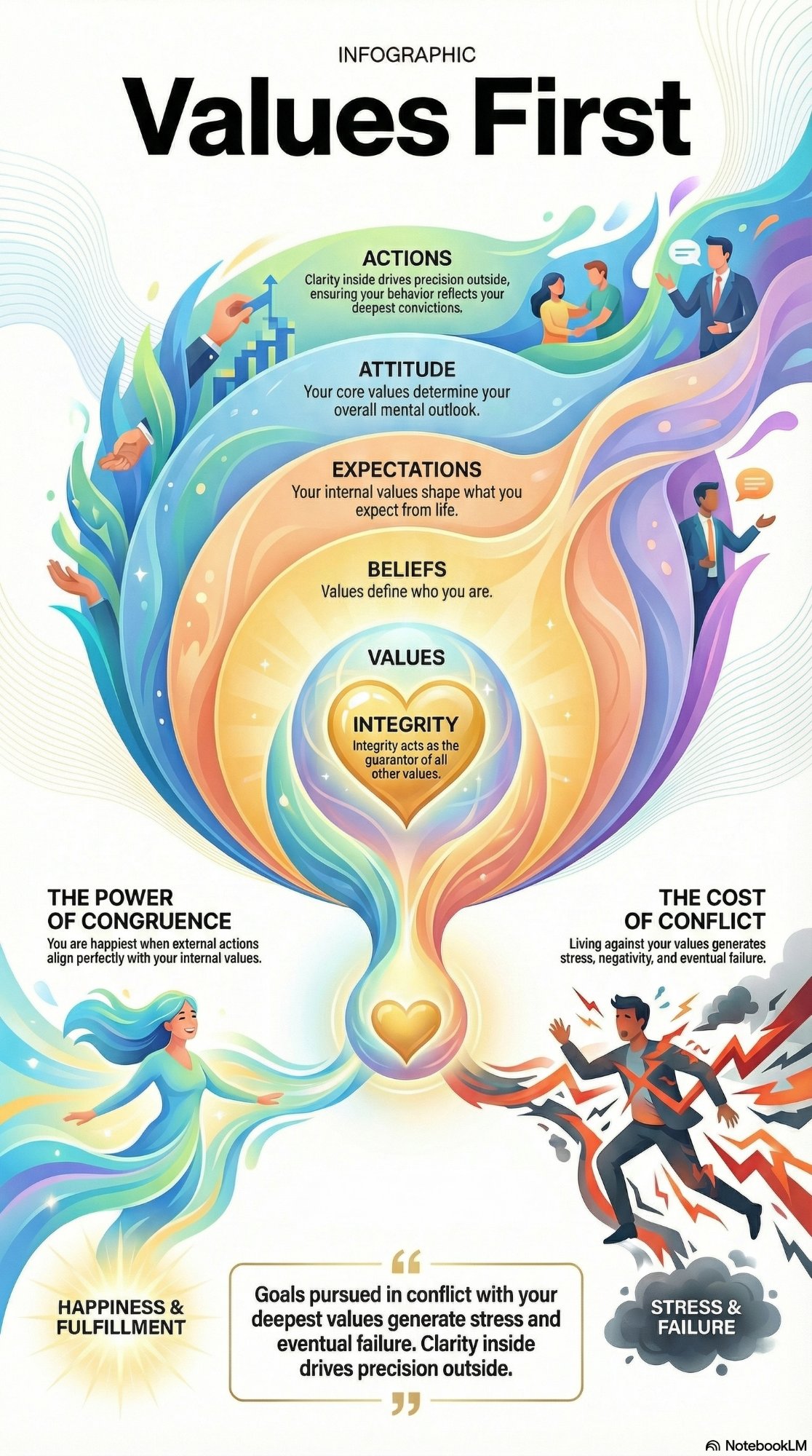
From integrity at the core to actions at the surface — and the two outcomes that follow from alignment or conflict. Created with NotebookLM.
Yvon Chouinard and the Soul of Patagonia
Few business stories illustrate Tracy's values principle more completely than the one Yvon Chouinard has been living since the 1950s. Chouinard began as a teenage climber making pitons in his parents' backyard, selling them from the trunk of his car. He wasn't trying to build a company. He was trying to make better gear for his friends and protect the rocks he loved climbing. Those two values, quality and environmental integrity, became the DNA of everything that followed.
When Chouinard noticed that his pitons were permanently scarring cliff faces, he did not hesitate. He stopped making them. He switched to removable aluminium chocks at a significant cost to the business. When Patagonia's rapid growth in the late 1980s began to feel like it was threatening the company's culture, he brought in a consultant who bluntly told him he could sell the company and give more money away than he ever could by running it. Chouinard's answer was to reject that logic entirely and double down on his values. He decided he was in business to prove that a company could operate on its own terms.
In the 1990s, Patagonia switched entirely to organic cotton, which was more expensive, harder to source, and not driven by consumer demand, because conventional cotton farming was destroying ecosystems, and that violated what Chouinard stood for. In 2011, the company placed a full-page ad on Black Friday under the headline "Don't Buy This Jacket," urging customers toward mindful consumption. In 2022, Chouinard transferred 100% of the company's ownership to environmental trusts, ensuring that every future dollar of profit would go toward fighting climate change. He described it simply: he needed to find a way to keep the company's values intact past his own lifetime.
Patagonia now generates hundreds of millions in annual revenue, boasts a 4% employee turnover rate, and commands extraordinary customer loyalty, not despite its values but because of them. As Chouinard himself put it: "Doing the right thing can help build your business." Tracy would recognise this immediately. When inner and outer are aligned, the energy available for achievement is enormous.
Oprah Winfrey — Values as Competitive Advantage
The Oprah Winfrey story appears in the main article, but it deserves a closer look here through the specific lens of values. Oprah's first television anchor job in Baltimore ended because she was deemed "too emotionally involved" in the stories she reported, too empathetic and too human. For most people, this would be a cue to suppress those qualities. Oprah did the opposite. She treated her empathy not as a liability but as her deepest value, the thing she was most fundamentally committed to. Her formula wasn't "here is what the market wants"; it was "here is what I believe, and I will find the audience that believes it too."
When The Oprah Winfrey Show first launched in Chicago, it followed the sensationalist format of most daytime television. After an episode where a woman found out on air that her husband had been unfaithful, Oprah made a conscious decision to change course entirely, regardless of what the ratings might do. She built the show around authenticity, empathy, and the sharing of genuine human experience. The format became revolutionary precisely because it was rooted in her actual values rather than genre convention.
Tracy writes that the greater clarity you have regarding your values on the inside, the more precise and effective your actions on the outside. Oprah's 25-season run, her production company, her network, her magazine, her philanthropy: each of these followed a values line that had been set early and held consistently, even when it was professionally risky to do so. The result was not just commercial success but a kind of cultural authority that no marketing strategy could have manufactured.
What Values Clarity Actually Looks Like
Tracy's prescription is practical: write down your values. Think about how you would behave if you were consistently living by them. Then refuse to compromise them for any reason. This sounds simple but is genuinely difficult, particularly when a financial opportunity, a social pressure, or a shortcut conflicts with what you believe.
What Chouinard and Oprah demonstrate is that the short-term cost of values-alignment is nearly always offset by a long-term advantage that has no equivalent. Customer loyalty that is rooted in shared values is more durable than loyalty earned through price. A creative voice that comes from a place of genuine conviction is more distinctive than one shaped to fit a trend. And a career built on what you actually believe is simply more sustainable, because you are not spending energy managing the gap between who you are and what you are doing.
The other articles in this series, especially Persist Beyond the Point, return to this theme. Persistence is almost impossible to sustain when you are pursuing goals that conflict with your values. The fuel runs out. When the goal and the values are aligned, the opposite happens: the work itself becomes the reward.