What separates the people who achieve remarkable things from those who spend their lives merely wishing? Brian Tracy's answer is disarmingly direct: a written goal, a plan, and the daily discipline to act on it. That's the beating heart of Goals!, a book built not from theory, but from a life that tested every principle it preaches.
First published in 2003 and based on more than 40 years of research and two decades of personal experience, Goals! How to Get Everything You Want, Faster Than You Ever Thought Possible has since reached over one million readers worldwide. It is not a book of comforting platitudes. Tracy writes like a man who once slept in his car and would rather hand you a working tool than a warm feeling. The result is one of the most practical and enduring works in the self-improvement canon.
Video Overview
Watch: A concise overview of the key ideas from Goals! by Brian Tracy
The Man Behind the Method
To understand Goals!, you first need to understand its author, since Brian Tracy did not write the book from a comfortable study lined with certificates. He wrote it from hard-won experience.
Born on January 5, 1944, in Charlottetown, Prince Edward Island, Tracy grew up in a household where the phrase "we can't afford it" was a daily refrain. His father struggled to hold steady employment; he and his three brothers relied on charity clothing. Rather than finish school, the teenage Tracy dropped out and spent nearly eight years drifting, working sawmills, logging camps, farms and construction sites, sleeping in cheap rooms or his car. He crossed the Sahara Desert with a group of friends, surviving a near-death experience in the harsh landscape. He trained under Dr. Albert Schweitzer in South Africa, earned a black belt in Shotokan Karate, and wandered through more than 80 countries before finding his footing.
His turning point came in sales. Untrained and unqualified, he began asking the top performers around him a simple question: How do you do it? He listened, applied what he learned, and within a year was the company's best salesman. Within two years, in his mid-twenties, he was vice president managing a team of 95 people.
The founding story of the Goals! philosophy is Tracy's own. Broke and directionless in his early sales career, he scrawled a single audacious goal on a piece of paper: to earn $1,000 a month in commissions. He never looked at the paper again. But simply writing the goal, making it concrete and real, seemed to rewire his focus. Within a month, he had discovered a new way to close sales he hadn't noticed before. He hit his target. From that day forward, the practice of writing down goals became the cornerstone of everything he built.
By 1981, Tracy decided to compile everything he had learned into a coherent system, one that would cut through the "fluff" he'd encountered in seminars and give people something they could actually use. He launched what became Brian Tracy International, now a global leadership-development firm that has consulted for over 1,000 companies. Goals! is the distillation of that life's work.
What the Book Covers, and Why It Matters
The book is structured around 21 interlocking principles, moving from mindset and self-belief through to practical strategies for time management, creativity, and persistence. Tracy's central argument is deceptively simple: most people never achieve what they're capable of because they never decide, clearly and in writing, what that actually is. Everything else follows from that act of clarity.
Write down your goals, make plans to achieve them, and work on your plans every single day.
Brian Tracy — Goals!The book begins by dismantling the comfort zone (the invisible cage that most people inhabit without realising it) and ends with an unflinching case for persistence as the ultimate determinant of success. In between, it walks the reader through goal-setting across every domain of life: career, finances, relationships, health, and personal growth.
The 21 Principles, Explained
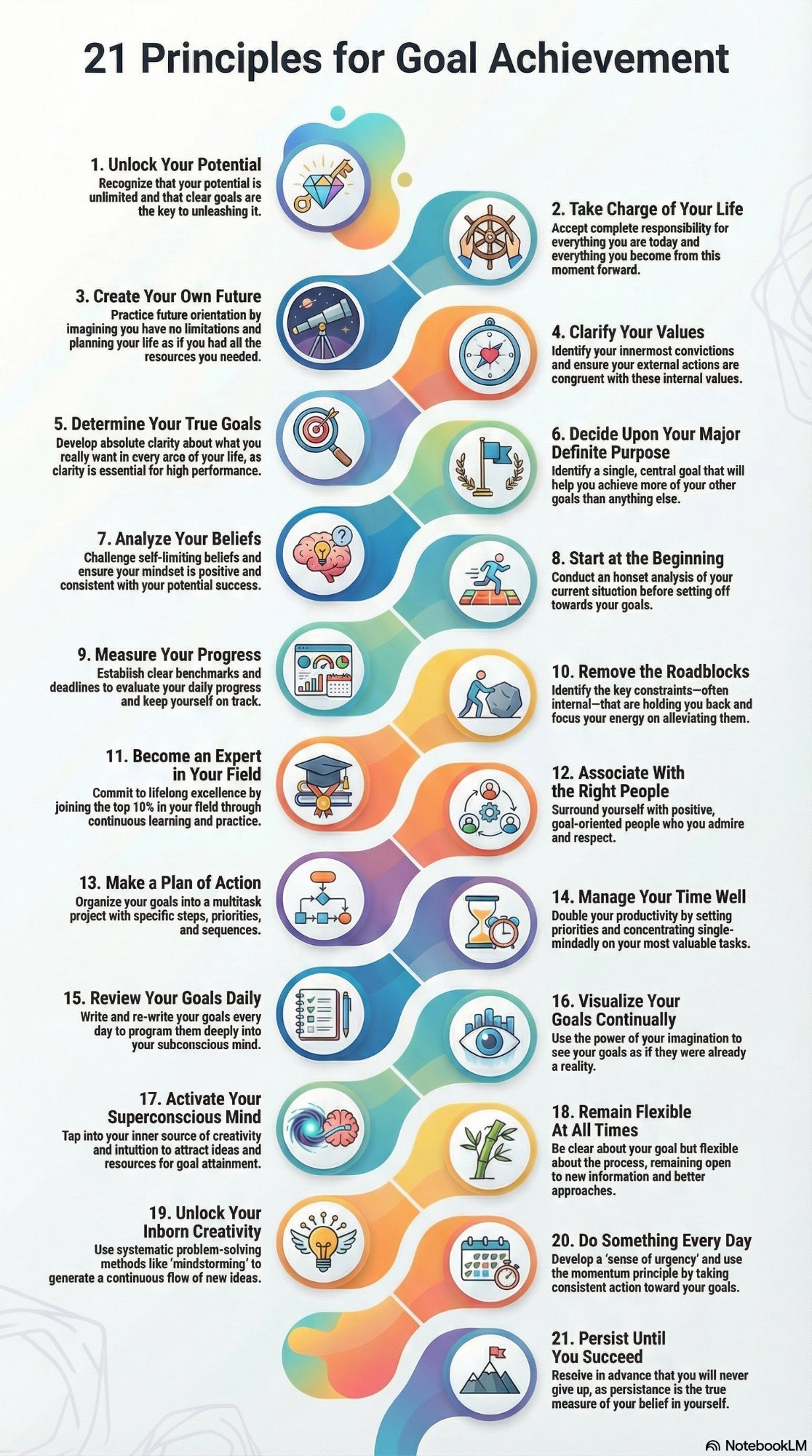
The complete 21-principle roadmap from Goals! — each step on the path from potential to persistence. Created with NotebookLM.
What follows is a guided tour through the book's core subjects, with the key ideas from each section.
 1. Unlock Your Potential
&
1. Unlock Your Potential
&
 2. Take Charge of Your Life
Tracy opens with a call to radical responsibility. He argues that accepting complete accountability for your life (your choices, your responses, your outcomes) is the single step that separates childhood from true adulthood. Being angry at someone, he notes pointedly, is allowing them to control your emotional state and often the entire quality of your life. The more responsibility you accept, the greater your sense of control, and the happier and more confident you become. It's a bracing place to begin.
 3. Create Your Own Future
&
3. Create Your Own Future
&
 4. Clarify Your Values
Long-term thinking, Tracy argues, is the single most important determinant of financial and personal success. Most people overestimate what they can accomplish in one year and dramatically underestimate what they can accomplish in five. Before setting a single goal, however, he insists you must understand your values, because any attempt to live in a way that contradicts your inner values will generate stress, pessimism, and quiet misery. Values flow into beliefs, beliefs shape expectations, expectations form attitude, and attitude drives action. The chain is explicit: get the foundation wrong, and the whole structure wobbles.
 5. Determine Your True Goals
&
5. Determine Your True Goals
&
 6. Your Major Definite Purpose
This is the heart of the book. Tracy asks readers to list their three most important goals right now across business, finance, family, health, and worry. He then asks the harder question: what have you always wanted to do but been afraid to attempt? Your "major definite purpose" is the one goal that, if achieved, would do more to improve your life than anything else. It becomes the north star around which everything else is organised.
The book famously opens with a story about a group of wealthy Chicago businessmen who, over dinner, debate the single factor most responsible for their success. After much discussion, the wisest among them offers the answer: the consistent habit of setting clear goals and pursuing them within a defined timeframe. Tracy uses this scene to frame the entire work, suggesting that the dividing line between the successful and the merely ambitious is not talent or luck, but this one practice.
 7. Analyse Your Beliefs
Tracy identifies self-limiting beliefs as the biggest single obstacle to goal-setting. These are the quiet, often unconscious convictions we hold about our own inadequacy: "I can't change careers," "I could never earn that much," "I'm not smart enough for that." He calls the most corrosive form of this "learned helplessness," rooted in destructive criticism during childhood and accumulated failures in adulthood. His prescription: question every self-limiting belief by asking, "What if this simply isn't true?" Then act as if you already possess the qualities you aspire to have.
 8. Start at the Beginning
&
8. Start at the Beginning
&
 9. Measure Your Progress
Tracy is ruthlessly practical here. Before you can plan a route, you need an honest GPS reading of exactly where you are right now. How much do you currently earn? What is your net worth today? How many minutes a day do you exercise? From that foundation, he introduces four powerful questions: Where are you now? Where would you ideally like to be? How did you get here, and what would you do differently? And what will you do now to bridge the gap? Goals, he insists, require deadlines, because a goal without a deadline is merely a discussion.
 10. Remove the Roadblocks
Tracy's analysis of obstacles is revealing: 80% of the constraints you face are internal (habits, fears, gaps in knowledge) and only 20% are genuinely external. The two greatest internal enemies are fear and doubt. The antidote is not courage in the cinematic sense, but the quiet accumulation of knowledge and skill. As competence grows, fear naturally diminishes. His advice: identify the single critical bottleneck between you and your goal, then focus all your energy on removing it.
 11. Become an Expert in Your Field
Excellence is not a gift. It is a decision. Tracy outlines eight signals that point toward your area of natural talent: the work that energises you, that you do well without enormous effort, that holds your attention even when no one is watching, that makes time disappear. He introduces the "3+1 formula": read in your field daily (even 15 minutes compounds dramatically over years), listen to educational audio, attend seminars, and then, crucially, apply what you learn immediately. He suggests you may be just one skill away from doubling your productivity.
 12. Associate With the Right People
Your reference group, meaning the people you habitually spend time with, shapes your outlook, your ambitions, and ultimately your outcomes more than almost any other factor. Tracy is direct: associate with people you admire, who are moving in the direction you want to go. Attend their associations, volunteer for committees, contribute generously with no expectation of return. One well-placed relationship at the right moment, he notes, can save years of hard work.
 13. Make a Plan of Action
&
13. Make a Plan of Action
&
 14. Manage Your Time Well
Planning transforms a dream into a multistep project with deadlines and sub-deadlines. Time management, Tracy argues, begins not with scheduling but with absolute clarity about what matters most. He introduces the ABCDE method, categorising every task by consequence before beginning, and the law of excluded alternatives: doing one thing always means not doing something else. The highest earners, he observes, plan their days in quarter-hours and practice "single-handling": starting the most important task and working on it without interruption until it's complete.
 15. Review Your Goals Daily
&
15. Review Your Goals Daily
&
 16. Visualise Continually
Tracy recommends writing out 10–15 goals every morning without referring to the previous day's list. Over time, the definitions sharpen, the priorities clarify, and the goals become deeply embedded in the subconscious. Coupled with vivid mental visualisation, seeing your goals as already achieved in detail, this daily practice, he argues, begins to activate forces of attraction and attentiveness that accelerate results. The four dimensions of effective visualisation are frequency, duration, vividness, and emotional intensity.
 17. Activate Your Superconscious Mind
Perhaps the book's most unusual chapter. Tracy uses "superconscious" to describe what many people call intuition, flow, or inspiration: those moments when a complete, brilliant solution arrives seemingly from nowhere. He argues this mental state is cultivated, not random: it emerges when you alternate intense focus with complete relaxation, when you clear your mind through exercise or solitude. A superconscious insight, he says, has three hallmarks: it answers every aspect of the problem, it feels obvious in retrospect, and it arrives with a burst of excitement.
Tracy's other famous book, Eat That Frog!, grew from his voracious reading habit; he reportedly reads for at least three hours daily and has worked through more than 7,000 books over his lifetime. The "frog" concept came from Mark Twain, who observed that if you eat a live frog first thing in the morning, you can go through the rest of the day knowing the worst is behind you. Tracy adapted this into a principle of productivity: tackle your most challenging, highest-value task before anything else. It's a philosophy entirely consistent with Goals!: confront the hard thing, do it now, don't sit and stare at it.
 18. Remain Flexible
&
18. Remain Flexible
&
 19. Unlock Your Creativity
Flexibility does not mean changing your goals; it means staying open about how you achieve them. Tracy introduces "zero-based thinking": regularly asking yourself whether, knowing what you know now, you would start doing something you're currently doing. If the answer is no, stop immediately. On creativity, he offers "mindstorming": writing a problem at the top of a blank page as a question, then generating at least 20 answers. The first ten come easily. The last ten are hard. The twentieth is often the one that changes everything.
 20. Do Something Every Day
&
20. Do Something Every Day
&
 21. Persist Until You Succeed
The book closes where all good action plans must: with momentum and persistence. Starting is hard. It takes considerable energy to overcome inertia, but once moving, far less energy is required to stay in motion. Tracy's final principle is both a warning and an encouragement: success almost always comes one step beyond the point where everything inside you says to quit. Character, he writes, is the ability to follow through on a resolution long after the enthusiasm that sparked it has passed.
Six Ideas Worth Carrying With You
Each of the six ideas below has its own deep-dive article with additional stories and context. Click any title to explore further.
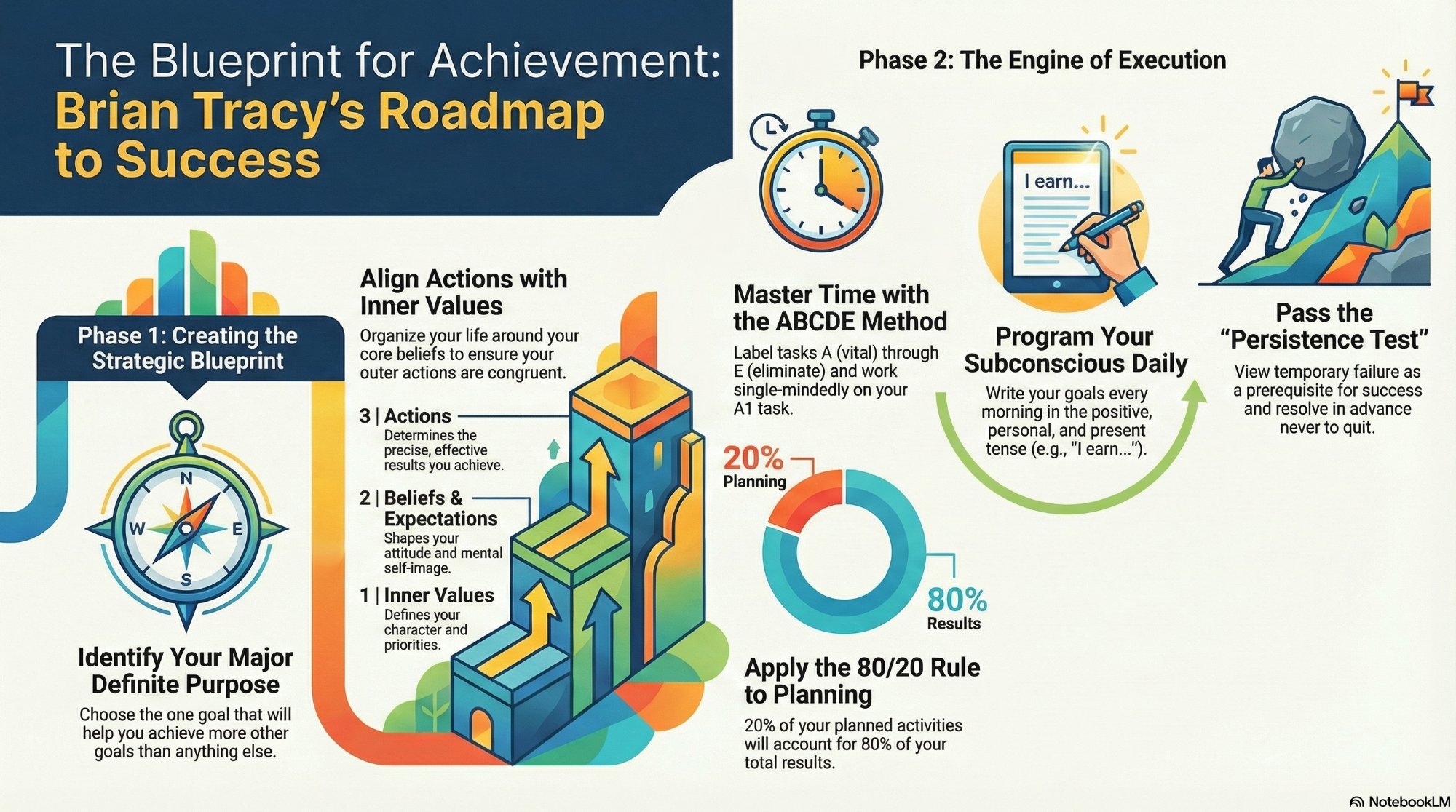
Tracy's two-phase framework condensed — the strategic foundation and the daily execution habits that drive results. Created with NotebookLM.
A goal that exists only in your mind is a wish. The physical act of writing a goal signals commitment to your subconscious and begins the process of its realisation.
Goals pursued in conflict with your deepest values generate stress and eventual failure. Clarity inside drives precision outside.
Two of your ten daily tasks will produce more value than the other eight combined. Identify them, do them first, and practise creative procrastination on the rest.
80% of the obstacles between you and your goal are internal. Fear diminishes as knowledge and skill increase, not before.
Rewriting your 10–15 goals each morning without reference to yesterday's list sharpens definition and embeds goals into the subconscious over time.
Great successes nearly always arrive one step beyond where most people give up. Persistence is self-discipline in motion, and the truest measure of belief in oneself.
Three Lives That Prove the Method Works
Tracy's framework didn't originate in a vacuum, and it hasn't stayed confined to the pages of a single book. Across different industries, eras, and starting points, the same core practices, including writing goals down, visualising outcomes with clarity, persisting through fear, and living by values, have appeared as the turning points in some of the most remarkable life stories of the modern era. Here are three of them.
In the early 1990s, Jim Carrey was a struggling actor doing stand-up in small clubs and scraping by in Los Angeles. He had talent, but no traction. Rather than waiting for an opportunity to find him, he did something that Tracy would recognise immediately: he made his goal concrete, specific, and time-bound. He wrote himself a cheque for $10 million, dated it Thanksgiving 1995, and noted it was for "acting services rendered." He kept it in his wallet as a physical daily reminder.
In an interview with Oprah Winfrey in 1997, Carrey described his nightly ritual of driving up to Mulholland Drive, looking out over the city, and vividly imagining himself working with directors he admired and receiving the kind of recognition he craved. He was not deluded about his circumstances; he was deliberately programming his focus. As he told Oprah: "I would visualize things coming to me that I wanted … and I had nothing at that time, but it just made me feel better." Then, just before Thanksgiving 1995, he found out he would be paid exactly $10 million for his role in Dumb and Dumber. The cheque had deteriorated in his wallet. When his father died that same year, Carrey placed it in the coffin with him. It had done its job. Oprah's own observation that day is worth noting: "Visualization works, if you work hard."
Growing up in Hollis, Queens, Daymond John was told by the world around him that his likely futures were limited. At 16, after reading Napoleon Hill's Think and Grow Rich, he started writing down his goals, every single morning when he woke up and every night before he slept. "These goals weren't just things I'd think about in the back of my mind. I'd actually write them down," he later wrote. He read them, closed his eyes, and visualised each one, working backward from the end result to what he needed to do that day.
At 23, he started FUBU (For Us, By Us) out of his mother's kitchen in Queens, teaching himself to sew on a borrowed machine and selling hats on street corners. He worked double shifts at Red Lobster to keep the lights on. Banks rejected his funding applications more than two dozen times. His mother eventually mortgaged the family home to keep the dream alive. After FUBU received $300,000 in orders from a Las Vegas trade show they couldn't even afford a booth at, a partnership with Samsung Textiles turned the brand into an empire. By the late 1990s, FUBU was posting over $350 million in annual global sales, ultimately generating more than $6 billion over its lifetime. John has credited that daily goal-writing habit, started at 16 and maintained for decades, as the foundation of everything he built.
Tracy writes that the greatest step from childhood to adulthood is accepting complete responsibility for your life, and that living in ways that contradict your deepest values will always generate stress and failure. Few lives illustrate both sides of this argument more powerfully than Oprah Winfrey's.
Born in poverty in rural Mississippi in 1954 to a teenage single mother, she suffered abuse, moved between unstable homes, lost a premature baby at 14, and had every statistical reason to disappear. What she also had was an early, fierce clarity about who she was and what she was for. When her father Vernon took her in at 14 and imposed structure and discipline, something clicked. She became an honour student, won awards for dramatic recitation, earned a full scholarship to Tennessee State University, and landed her first radio job in Nashville while still at school. Her first TV anchor role in Baltimore ended badly. She was fired for being "too emotionally involved" in her stories. Rather than suppress that trait, she leaned into it, eventually taking over a struggling Chicago morning show that would be renamed The Oprah Winfrey Show and become the highest-rated daytime talk programme in history.
The key, she has consistently said, was not the pursuit of success itself, but absolute alignment between her work and her values. "If you want to have success, you can't make success your goal. The key is to work toward being significant, and the success will naturally follow." That is Tracy's principle of values clarification rendered into one of the most documented life transformations in modern history.
What connects these three stories, including Tracy's own, is not a shared background, industry, or level of talent. It's a shared set of practices: writing goals down with painful specificity, reviewing them daily, visualising outcomes vividly, living in alignment with deeply held values, and persisting when the evidence for quitting was overwhelming. Tracy didn't invent these practices. He codified what was already working and gave it a structure anyone can follow.
Is Goals! Worth Your Time?
The criticism sometimes levelled at Tracy, that his work is optimistic to the point of naïveté, misses the texture of the book. He doesn't promise that writing goals will produce them by magic; he explicitly warns that achievement requires years of hard work, failure, and adjustment. What he offers is a system: a structured way to channel effort so that those years aren't spent wandering.
The real power of Goals! is that it was written by someone who genuinely had nothing, found a method that worked, and spent the rest of his life pressure-testing it across more than 80 countries and a thousand companies. The method held. That's a harder thing to dismiss than most self-help books can claim.
Tracy's final question, posed in the book's last pages, is worth sitting with: The most important question for your future now is simply this: will you do what you have resolved to do? Everything else, all 21 principles and 300 pages, is preparation for that answer.
Ready to put Tracy's method to work?
If this article resonated with you, the book goes far deeper — with exercises, self-assessments, and Tracy's full 21-step system laid out in a way you can start using today. It's the kind of book that pays for itself many times over.
Get Goals! on Amazon →As an Amazon Associate I earn from qualifying purchases. This doesn't affect the price you pay.