
Of all the ideas in Tracy's framework, the 80/20 rule may be the most immediately actionable, and the most brutally honest. It tells you something most people would rather not hear: most of what you do today will not meaningfully move your life forward. Two tasks on your list will account for the majority of the value you create. The rest is largely noise.
The principle did not originate with Tracy. It was first observed by Italian economist Vilfredo Pareto in 1896, who noticed that approximately 80% of Italy's land was owned by 20% of the population, and that similar distributions appeared across every country and context he studied. The engineer Joseph Juran later applied the principle to quality management, calling it "the vital few and the useful many." Tracy applies it to your daily task list, your career, and your life.
Your Ten Tasks and the Two That Matter
Tracy's instruction is clear: before you begin work each day, review your full list of tasks and assign each one a letter using the ABCDE method. The 'A' tasks, those with serious consequences for non-completion, must always be done first. 'B' tasks are something you should do, with mild consequences if you don't complete them. 'C' tasks are nice to do but have no consequences at all on your work or life. The 'D' tasks can be delegated. The 'E' tasks can be eliminated entirely. The crucial insight is that completing 20% of the right tasks will generate 80% of the day's value. The temptation is always to clear the smaller, easier tasks first. Tracy calls this procrastinating on your most important work.
20% of your activities will account for 80% of the value of all of your activities. Two of your ten tasks will have greater potential consequences than the other eight.
Brian Tracy — Goals!This principle connects directly to the advice in Persist Beyond the Point: persistence is only valuable when it is directed at the right target. Persisting on the wrong 80% is simply an efficient way to stay busy while going nowhere. The 80/20 rule forces a prior question: what is actually worth persisting on?
of your results come from 20% of your efforts
of Microsoft's crashes were fixed by addressing just 20% of reported bugs
of revenue typically comes from 20% of a company's clients
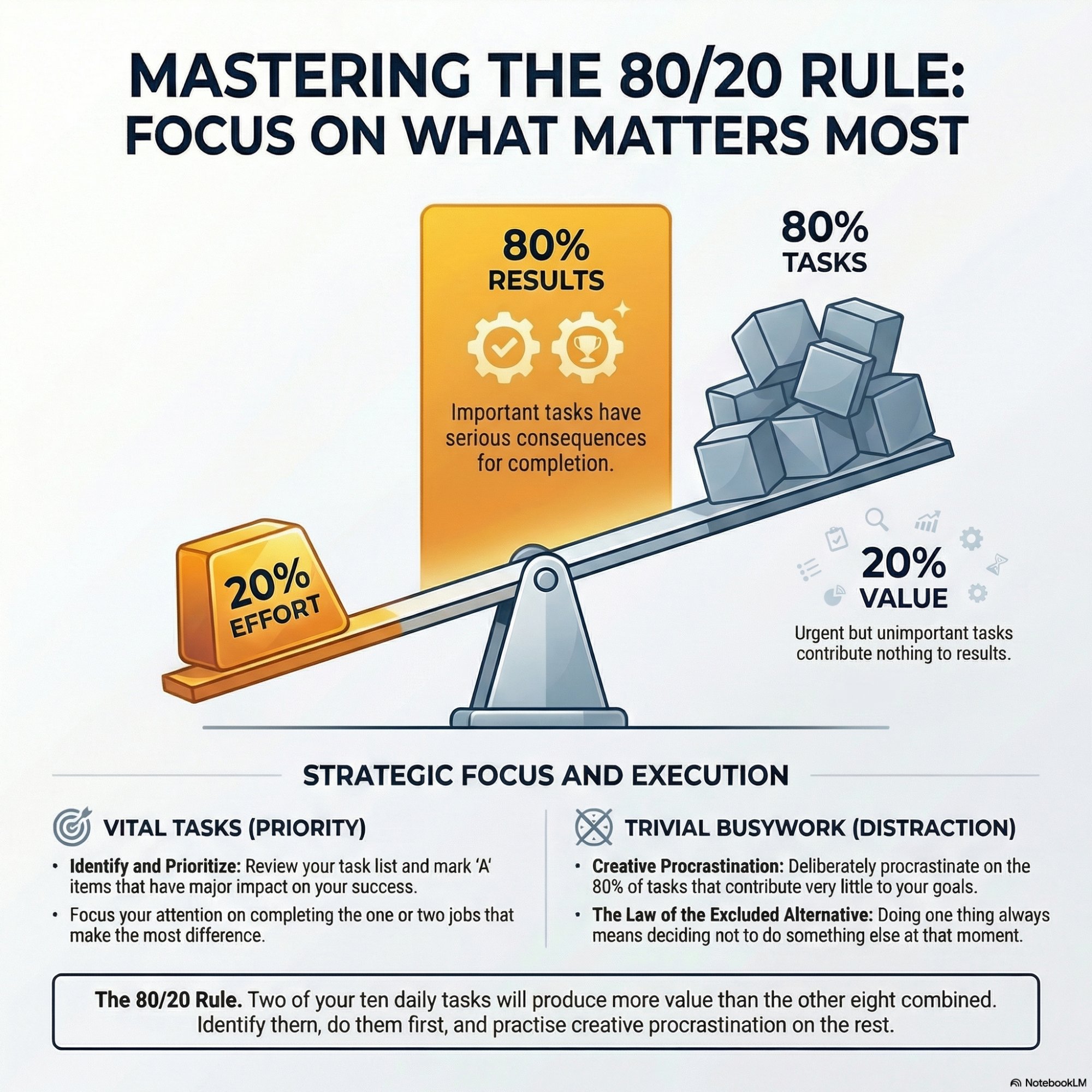
20% of effort produces 80% of results — and the discipline of creative procrastination on the rest. Created with NotebookLM.
Apple and the Return of Steve Jobs
When Steve Jobs returned to Apple in 1997, the company was weeks from bankruptcy, producing over 40 products across a sprawling and unfocused range. Jobs applied an instinctive version of Pareto's principle to the entire product line. He identified the small number of products that were generating, or could generate, the overwhelming majority of Apple's value, and cut everything else. The product matrix he introduced famously reduced Apple's offering to four products: two consumer, two professional.
The decision was radical and internally controversial. Engineers and product managers who had spent years on the discontinued lines were devastated. But Jobs understood something that the 80/20 principle makes explicit: spreading resources across 40 products means every product gets 2.5% of the company's attention. Concentrating on four means each product gets 25%. The compounding effect on quality, marketing clarity, and engineering depth was transformative.
The iMac launched the following year, the iPod in 2001, the iPhone in 2007. Each was the product of a company that had learned to ruthlessly identify its vital 20% and give it everything. By applying what Pareto would recognise as his own principle, Jobs took Apple from near-bankruptcy to the most valuable company in the world. The 80% of products he eliminated were not just costs; they were distractions from the work that actually mattered.
Michael Jordan and the Vital Skill
Tracy's version of the 80/20 rule in personal development asks a pointed question: which single skill, if you improved it dramatically, would have the greatest impact on everything else you do? He calls this the "one skill away" insight, the idea that focused development of your most valuable capability can double productivity faster than spreading effort across many areas.
Michael Jordan was cut from his high school basketball varsity team because he was considered too short. Rather than respond by trying to improve everything at once, Jordan did something more focused: he identified the specific skills that mattered most in basketball, and practised them at a level no one around him could match. He is reported to have practised after team training sessions were already finished, adding volume his competitors didn't know to account for. He visualised his performance in specific scenarios. He isolated and drilled the details: the moves, the finishes, the mid-range shots that would account for the majority of the difference between good and elite.
Jordan went on to win six NBA championships, was named Finals MVP all six times, and is considered by most analysts the greatest basketball player who ever played. His career was not built on trying to be equally good at everything; it was built on being exceptional at the specific things that mattered most at the highest level. The 80/20 rule, applied not to a task list but to a person's deliberate development.
How to Apply This Today
The 80/20 rule asks for something most people are reluctant to do: deliberately ignore the majority of what is on their plate. Not forever, but for now, in favour of the few things that will create the most value. Tracy's practical guidance is to write your task list, assign it letters A through E, and then practice what he calls "creative procrastination" on the bottom 80%, deliberately putting off the low-consequence tasks in favour of your top two or three.
The discipline this requires connects to the Write It Down principle. When you have written your goals with clarity, the A-tasks become obvious: they are the ones that move you directly toward the life you have defined. The B and C tasks are the noise that feels urgent but matters very little. The challenge is not identifying the 20%. With a written goal list, that is usually clear. The challenge is having the discipline to act on it.