
Tracy's analysis of fear is one of the most useful passages in Goals!, not because it offers comfort, but because it refuses to. He does not suggest that successful people are fearless. He suggests that they have learned to move anyway. The courageous person, in his view, is simply one who goes forward in spite of fear, and who understands that fear diminishes as you move toward it, and grows as you avoid it.
The statistic he cites is sobering: 80% of the constraints on your success are internal. They live in your habits, your beliefs, your fears, and your self-doubt, not in the market, not in the economy, not in other people. This is not a counsel to ignore external obstacles. It is a call to stop pretending they are the primary problem.
The Two Enemies: Fear and Doubt
Tracy names two specific psychological enemies: fear of failure and self-doubt. The fear of failure, rooted in a dread of embarrassment, rejection, or loss, causes most people to never begin at all. Self-doubt is the companion: the quiet voice that compares you unfavourably to others and finds you short. Together they produce what Tracy calls "learned helplessness": the conviction, often acquired in childhood through criticism or failure, that you are simply not capable of the things you most want to achieve.
Courage is not the absence of fear. It is the resistance to fear and mastery of fear. The courageous person is simply one who goes forward in spite of the fear.
Brian Tracy — Goals!The antidote Tracy prescribes is not motivational rhetoric but practical action: develop knowledge and skill. Most fear, he argues, arises from ignorance and a sense of inadequacy. As competence grows, fear naturally diminishes. This connects to what is explored in the Persist Beyond the Point article: it takes courage to begin, and the beginning is almost always the hardest part.
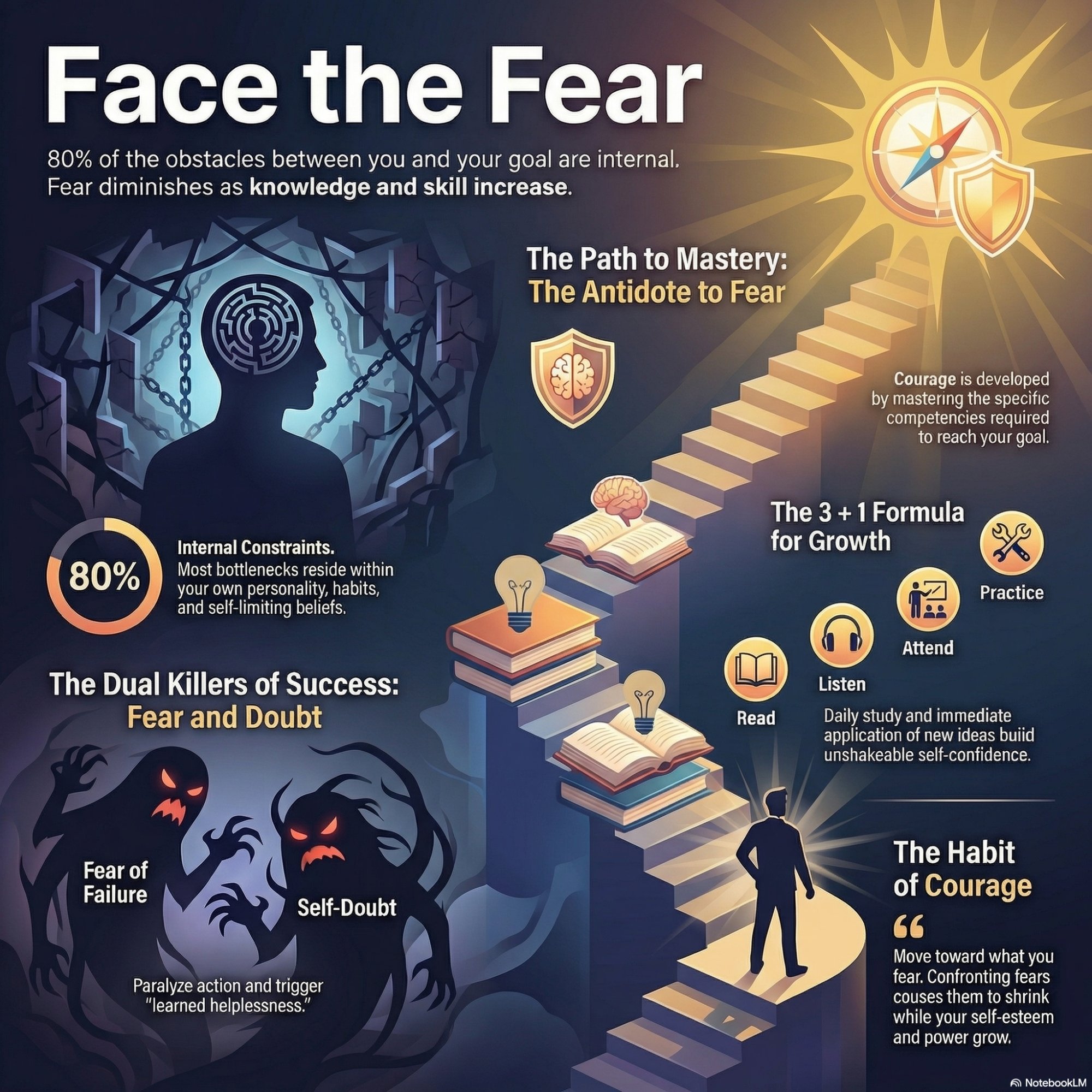
From internal constraint to the habit of courage — the framework for moving through fear rather than waiting for it to pass. Created with NotebookLM.
J.K. Rowling — Rejection as a Corridor
Before Harry Potter became the best-selling book series in history, it was rejected by twelve publishers. J.K. Rowling wrote the first book while unemployed, a single mother, and on welfare, circumstances that would give most people rational cause to stop. She continued. The fear of further rejection was real; the doubt about whether the book had merit was real. What Rowling did, and what Tracy's framework would recognise immediately, was move forward despite those feelings, not after they subsided.
The twelfth publisher who rejected the manuscript was followed by the thirteenth, Bloomsbury, who accepted it in 1997, in part because the chairman's eight-year-old daughter read the first chapter and demanded the rest. The series went on to sell over 500 million copies and generate a franchise worth billions. None of that existed at the moment of the twelfth rejection. The corridor Tracy describes, the idea that as you move forward, doors open that you could not see from where you were standing, is exactly what Rowling's story illustrates.
What she had, in the absence of certainty, was the clarity of her goal and the willingness to absorb rejection without treating it as a verdict on her worth or her work. Tracy writes that fear is often caused by ignorance, though in Rowling’s case, the knowledge she needed was not about writing. It was about the business of publishing, which she learned by continuing to submit. Each rejection taught her something. The knowledge reduced the fear. She persisted.
Jim Carrey — Vulnerability as Fuel
The Jim Carrey story in the main article focuses on his $10 million visualisation. But there is a dimension of that story that speaks directly to fear: the act of writing the check itself was an act of courage. It required him to declare, to himself and to the universe, a specific number, one that no rational accounting of his circumstances at the time could justify. Declaring a goal you have no current evidence of achieving is vulnerable. It opens you to the possibility of being publicly wrong. Carrey did it anyway.
In his 1997 Oprah interview, Carrey described the emotional state that preceded his nightly visualisation sessions: "I would visualize things coming to me that I wanted, and I had nothing at that time. But it just made me feel better. I would drive home and think, well, I do have these things. They're out there. I just don't have a hold of them yet." That framing, "I just don't have a hold of them yet" is a masterclass in reinterpreting fear. He wasn't denying his circumstances. He was refusing to let them be the last word.
Tracy's advice on fear includes this exact reframe: switch your attention from the obstacle to the goal. Create a clear mental picture of the person you want to be. Nothing is wrong with thoughts of fear, he writes, as long as you temper them with thoughts of courage and self-reliance. Carrey's nightly drive was precisely that practice: not the elimination of fear, but the deliberate choice to feed the goal alongside it.
Michael Phelps — Preparing for Disaster
Most people, when they think about overcoming fear, imagine suppressing or eliminating it before a high-stakes moment. Michael Phelps and his coach Bob Bowman took the opposite approach: they deliberately introduced worst-case scenarios into training so that fear of them would have nothing new to offer on race day.
As part of his visualisation practice, Phelps didn't only imagine perfect races. He imagined his suit ripping, his goggles filling with water, his start going wrong. Bowman sometimes deliberately broke Phelps's goggles during practice runs so he could experience swimming blind in a controlled environment. The goal was to make the worst possible scenario familiar and therefore manageable.
At the 2008 Beijing Olympics, during the 200m butterfly final, Phelps's goggles filled with water at the start and he swam the last 75 metres completely blind. He didn't panic. He counted his strokes exactly as he had practised, hit the wall at precisely the right moment, and won the gold medal in world record time. He had already lived through that fear so many times in training that it had lost its power. Tracy's instruction to develop courage by repeatedly behaving courageously was operationalised into a physical training protocol by one of the greatest athletes in history.
Moving Forward Anyway
Tracy's most important observation about fear is also his simplest: whenever you avoid what you fear, your fears grow. Whenever you move toward what you fear, they diminish. There is no third option. The fear will not become smaller while you wait. It only becomes smaller by being walked through.
The three stories above, a writer submitting to her thirteenth publisher, an actor declaring a specific sum he had no current evidence of earning, and a swimmer practising blindly in a pool, all demonstrate the same principle from different angles. The fear was real in every case. The action happened anyway. And in every case, the action produced knowledge, competence, or clarity that the fear had been blocking.
The relationship between this article and Write It Down is worth noting: a written goal is also a named fear. It says, explicitly, "I intend to do this thing I am not certain I can do." That naming is itself an act of courage. Everything else follows from it.