Most personal-finance books are written from the outside in: a journalist collates research, a professor cites studies, and a tidy theory arrives neatly packaged for the reader. Keith Cameron Smith took the opposite approach. Born in 1971 into a lower-middle-class family in Shreveport, Louisiana (his father drove routes selling auto parts to small garages), Smith built his way upward through furniture retail, then real estate, then the speaking circuit, observing at close range what separated people who accumulated wealth from those who remained permanently comfortable but never free.
His findings, first self-published in 2005 and later picked up by Ballantine Books as part of Random House, are disarmingly compact: ten distinctions, not strategies. Not tips. Distinctions: differences in how people think, speak, and see the world long before they touch a spreadsheet or open a brokerage account. The argument at the heart of the book is that financial outcomes are downstream of mental habits, and that those habits can be identified, examined, and changed.
This article walks through each of Smith's ten distinctions, draws out the key insight of each, and anchors them in the stories of real people whose lives made the same argument, sometimes knowingly and sometimes simply by living it.
Origin Story
The Man Behind the Method
Smith's path from Shreveport to the speaker's circuit runs through a used furniture store he opened in Ormond Beach, Florida, a deliberately unglamorous beginning that he has never tried to dress up. The furniture business grew into a small chain, which taught him the mechanics of profit: buying something for one price and selling it for more. Later, real estate investing gave him his first exposure to passive income and the compounding power of assets. He was not a prodigy; he was a practitioner.
His first book, The Spiritual Millionaire, released in 2004, put him in front of audiences including a spot on Dr. Robert Schuller's Hour of Power. But it was his second book, the one built from the pattern-matching he'd done across a career spent around both wealthy and middle-income people, that became his calling card. The 10 Distinctions series now runs to ten volumes. The original, on millionaires and the middle class, earned praise from Mark Victor Hansen, co-author of Chicken Soup for the Soul, who wrote that its principles were available to everyone willing to study and apply them.
Smith's central observation is not that rich people work harder. It is that they think differently, and that the difference in thinking begins well before any money changes hands.
Overview
What the Book Argues, and Why It Matters
The book is structured as a countdown from ten to one, moving from the most externally observable distinctions toward the most fundamental. The outer distinctions (time horizon, conversational content, openness to change) are habits that can be practised almost immediately. The inner distinctions (generosity, empowering self-questioning, net worth versus paycheck focus) require a deeper shift in belief.
Smith's core argument can be stated simply: the middle class organises its financial life around income, while millionaires organise theirs around assets. The middle class thinks in months; millionaires think in decades. The middle class plays not to lose; millionaires play to win. And the middle class, crucially, asks itself questions that confirm its limitations, while millionaires ask questions that expand their possibilities.
"Millionaires do today what others don't, so they can have tomorrow what others won't."
Keith Cameron SmithNone of this is presented as moralising. Smith does not suggest that middle-class people are lazy or foolish. He suggests that they are following a script they were handed, and that the script can be rewritten. What follows is a guided tour of all ten distinctions, from the outermost ring to the centre.
The Framework
The Ten Distinctions, Explained
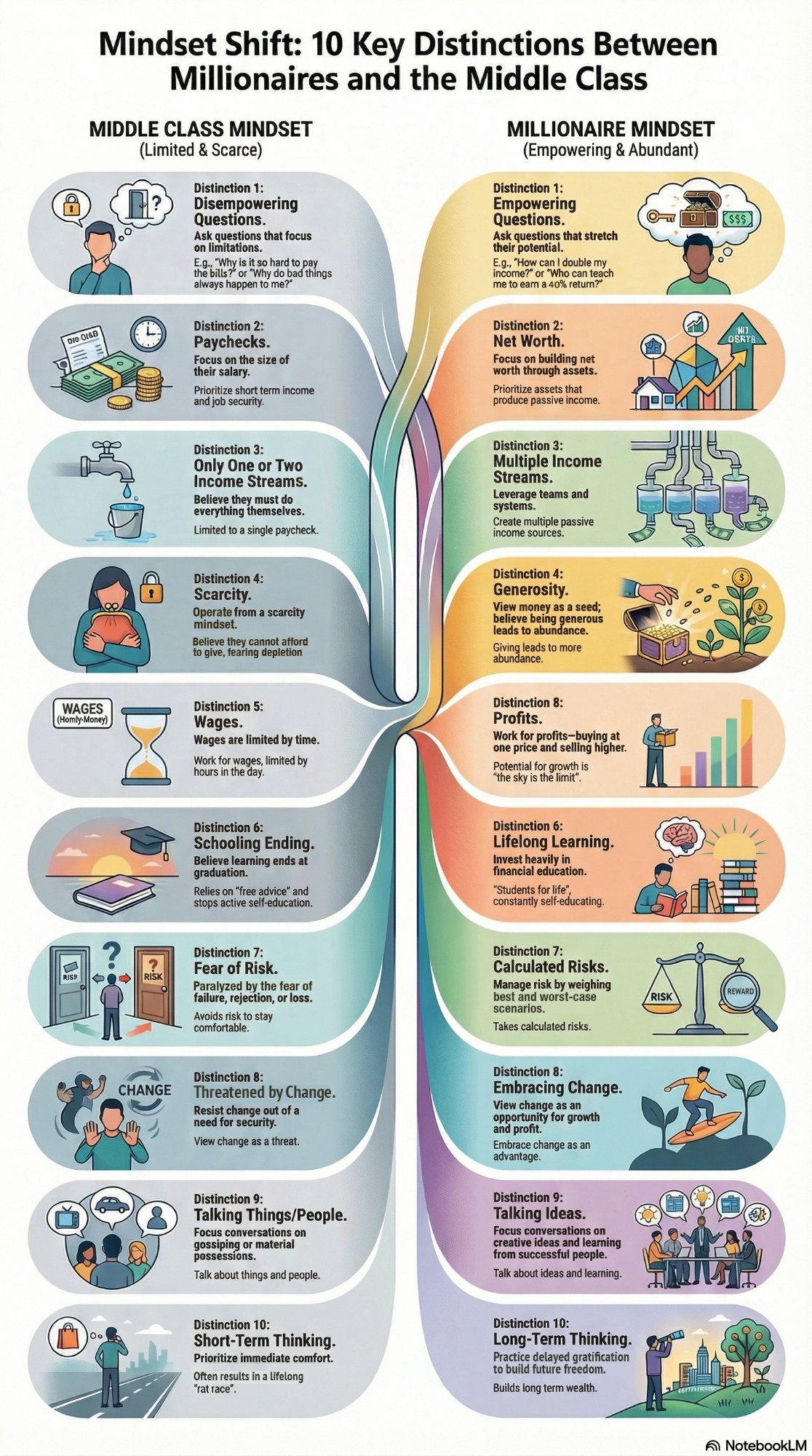
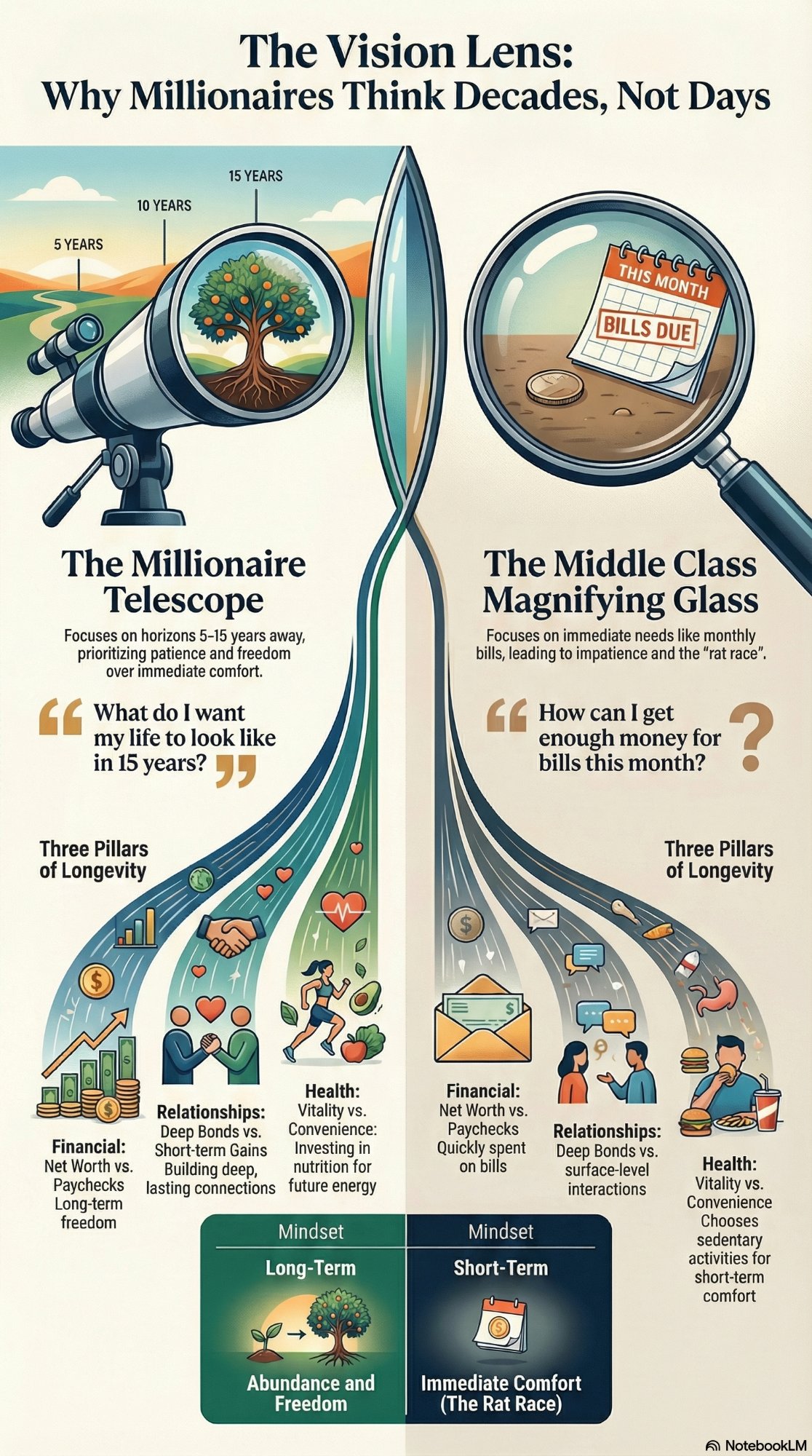
10. Millionaires Think Long Term. The Middle Class Thinks Short Term.
Smith opens with time horizon because he considers it the master variable. Nearly every other distinction flows from it. A person who is thinking five or ten years ahead will tolerate discomfort today that a short-term thinker cannot. They will plant seeds in a business, in a relationship, in their own knowledge, seeds that will not fruit for years, and they will do so patiently, because they can already see the harvest.
The middle class, he argues, is trapped by impatience. It values comfort over freedom, which means it chooses the relief of a stable paycheck over the uncertainty of building something. It is not a character flaw so much as a mental habit, one that can be interrupted simply by asking different questions. Smith recommends asking yourself not "how do I get through this month?" but "what do I want my life to look like in ten years?" and then working backward.
Warren Buffett: The Patient Investor
Few lives demonstrate long-term thinking as visibly as Warren Buffett's. At eleven years old, he bought his first stock. What he has described consistently ever since is a preference for holding positions not for quarters but for decades; in his words, his favourite holding period is "forever." His approach to acquiring GEICO illustrates the principle precisely: he began purchasing shares in 1951 and waited 45 years until Berkshire Hathaway acquired the entire company in 1996.
More striking still is his approach to delayed gratification in philanthropy. For decades, critics interpreted his reluctance to give away his fortune quickly as miserliness. What they missed, as analysis from selfemployed.com noted, was that Buffett was operating from an abundance rather than a scarcity mentality, allowing his resources to compound so that, when eventually deployed, they would create far greater impact than earlier giving could have. He ultimately pledged more than 99% of his wealth to charitable causes.
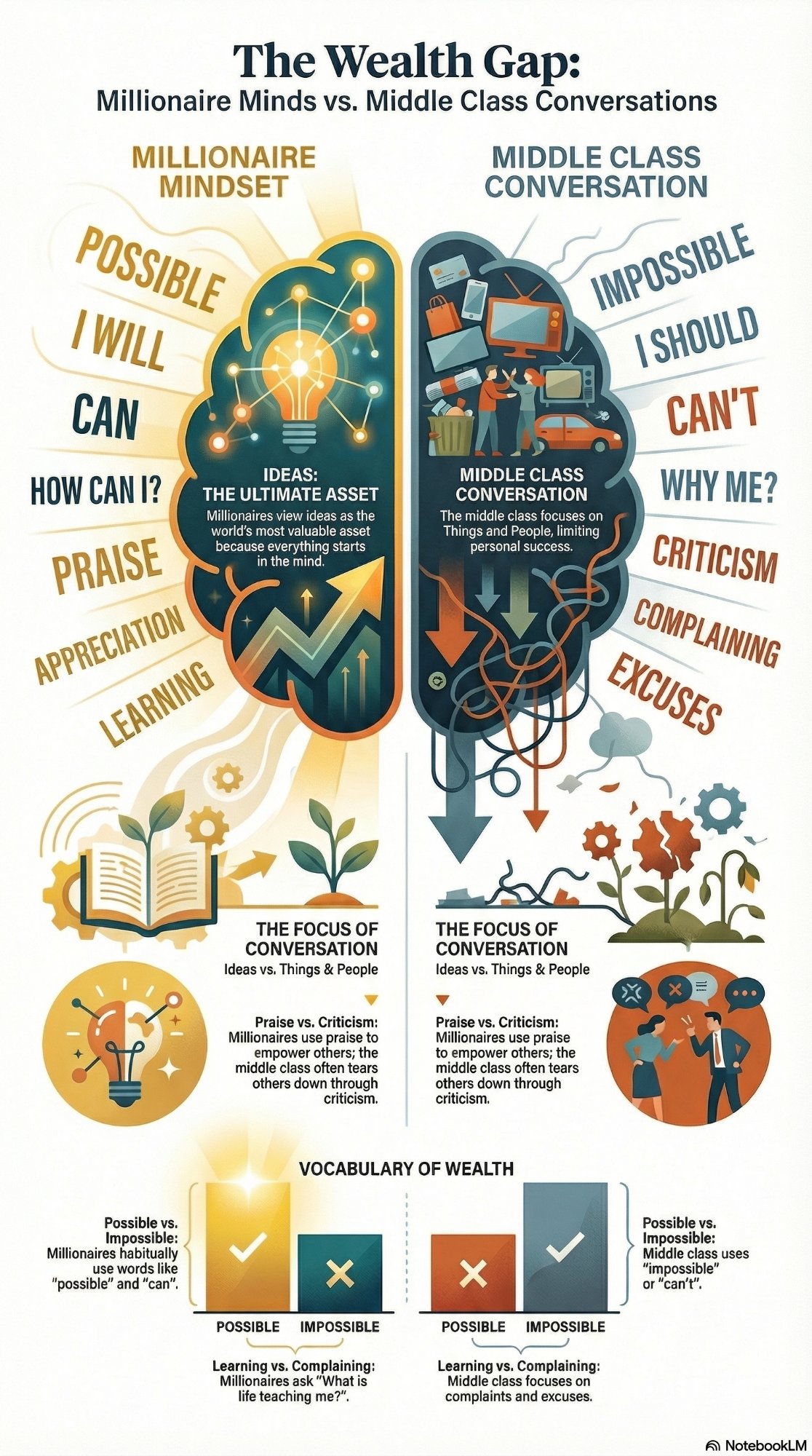
9. Millionaires Talk About Ideas. The Middle Class Talks About Things and Other People.
This distinction is easy to observe in any social setting. Smith is careful not to frame it as snobbery; millionaires, he notes, also talk about people and things, but differently. They discuss what an entrepreneur built and what can be learned from it. They ask what-if questions. They use words like "possible" and "can" and "I will." The middle class, by contrast, often fills its conversations with complaint, gossip, and the details of other people's choices.
The mechanism behind this distinction is that ideas are the seed of every financial outcome. Everything that exists — every product, every business, every service — started as an idea in someone's mind. If you want more money, Smith argues, spend more time generating, sharing, and stress-testing ideas with people who are positioned to respond constructively. He is direct about one thing: do not share your ideas with people who have a limited mentality. They will discourage you. Find people who are already operating at the level you aspire to reach.
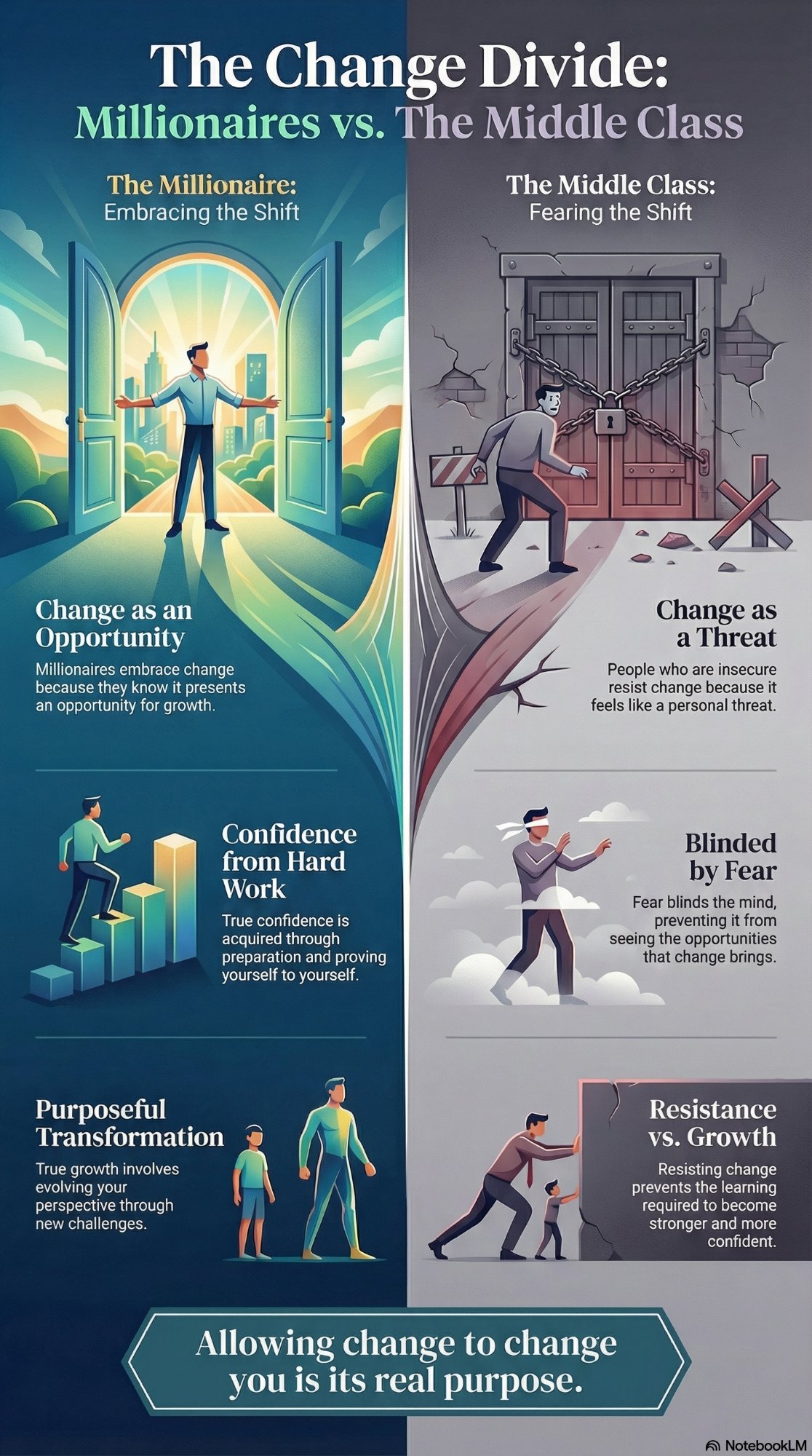
8. Millionaires Embrace Change. The Middle Class is Threatened by Change.
Change is either an opportunity or a threat, and which one it is depends almost entirely on your confidence. Smith's observation here is psychologically precise: insecure people resist change because change introduces uncertainty, and uncertainty feels dangerous when you do not trust yourself to handle whatever comes next. Confident people — and confidence, he is careful to note, is the product of preparation and hard work, not a personality trait — lean into change because they know it tends to open doors.
The practical prescription is to focus on becoming the kind of person who can benefit from change, rather than trying to prevent change from happening. The more capable you become, the less threatening the unknown feels.
Sara Blakely — Turning a Problem into a Billion-Dollar Idea
In the late 1990s, Sara Blakely was selling fax machines door-to-door in Atlanta. She had failed the Law School Admission Test twice. On the evening of a party, unable to find anything comfortable to wear under white trousers, she cut the feet off a pair of control-top pantyhose — and noticed, in that small domestic experiment, a problem that millions of women shared and no one had solved well.
Rather than treating the situation as a constraint, Blakely treated it as information. She spent her $5,000 in savings, wrote her own patent application to keep costs down, called fabric manufacturers until one agreed to help, and launched Spanx in 2000 without any outside investment. The company was profitable in its first year, generating $4 million in revenue. In 2021, Blackstone acquired a majority stake valuing Spanx at $1.2 billion. Every manufacturer she originally called had turned her down.
7. Millionaires Take Calculated Risks. The Middle Class is Afraid to Take Risks.
Smith draws a precise distinction between recklessness and calculated risk-taking. The key word is calculated: gain knowledge first, consider the consequences of failure before acting, and then run three questions through your assessment. What is the best thing that could happen? What is the worst? What is the most likely outcome? If you can live with the worst case, and the most likely case moves you toward your goals, proceed.
The three fears that stop the middle class from taking action are, in Smith's framework: fear of failure, fear of rejection, and fear of loss. Fear of loss is the subtlest and perhaps the most debilitating — it causes people to play financial defence their entire lives, protecting what little they have rather than trying to multiply it. The result is that they never win; they only manage not to lose for as long as possible, until circumstances overwhelm them anyway.
"The biggest gap in the world is between 'I should' and 'I did'. Millionaires say 'I did' and the middle class say 'I should'."
— Keith Cameron Smith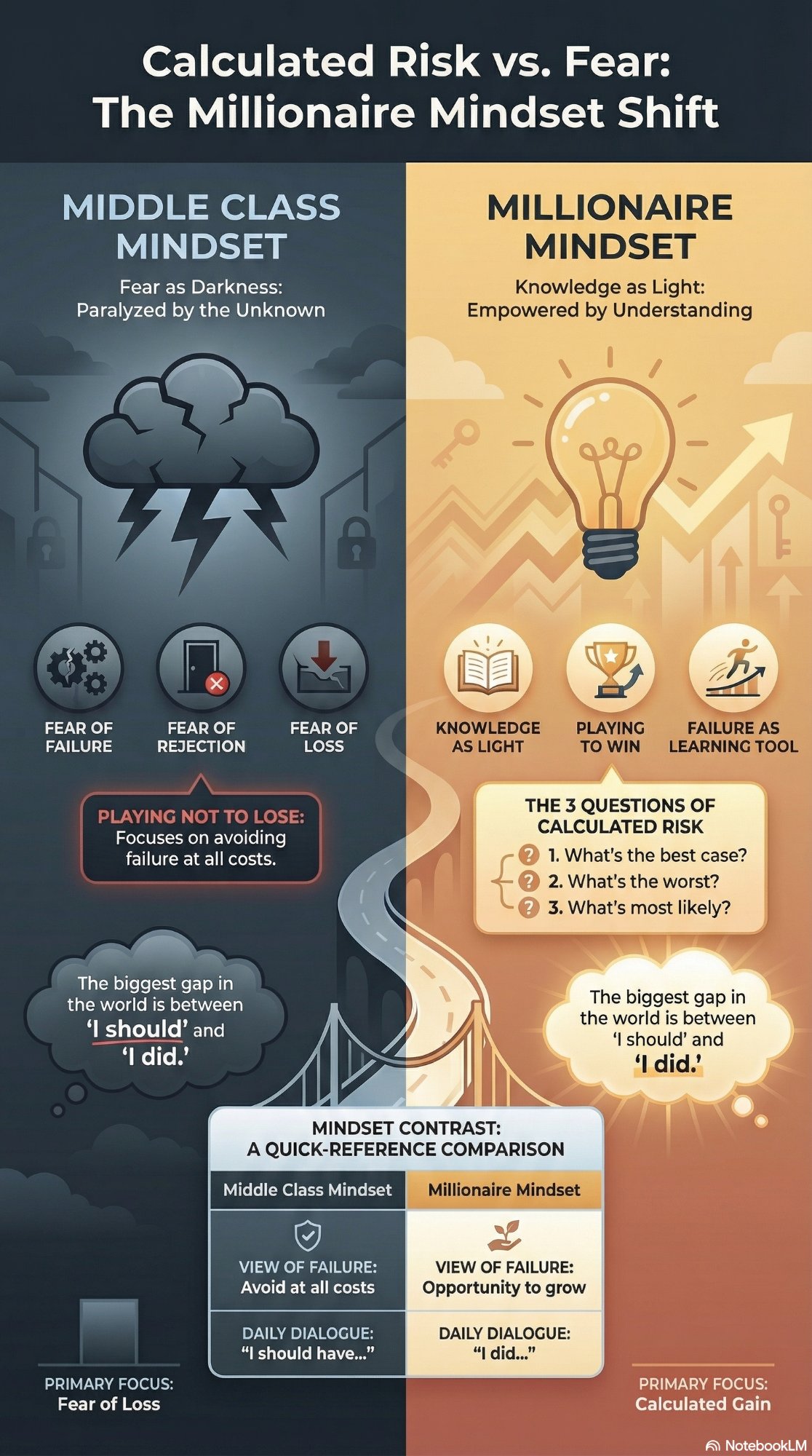
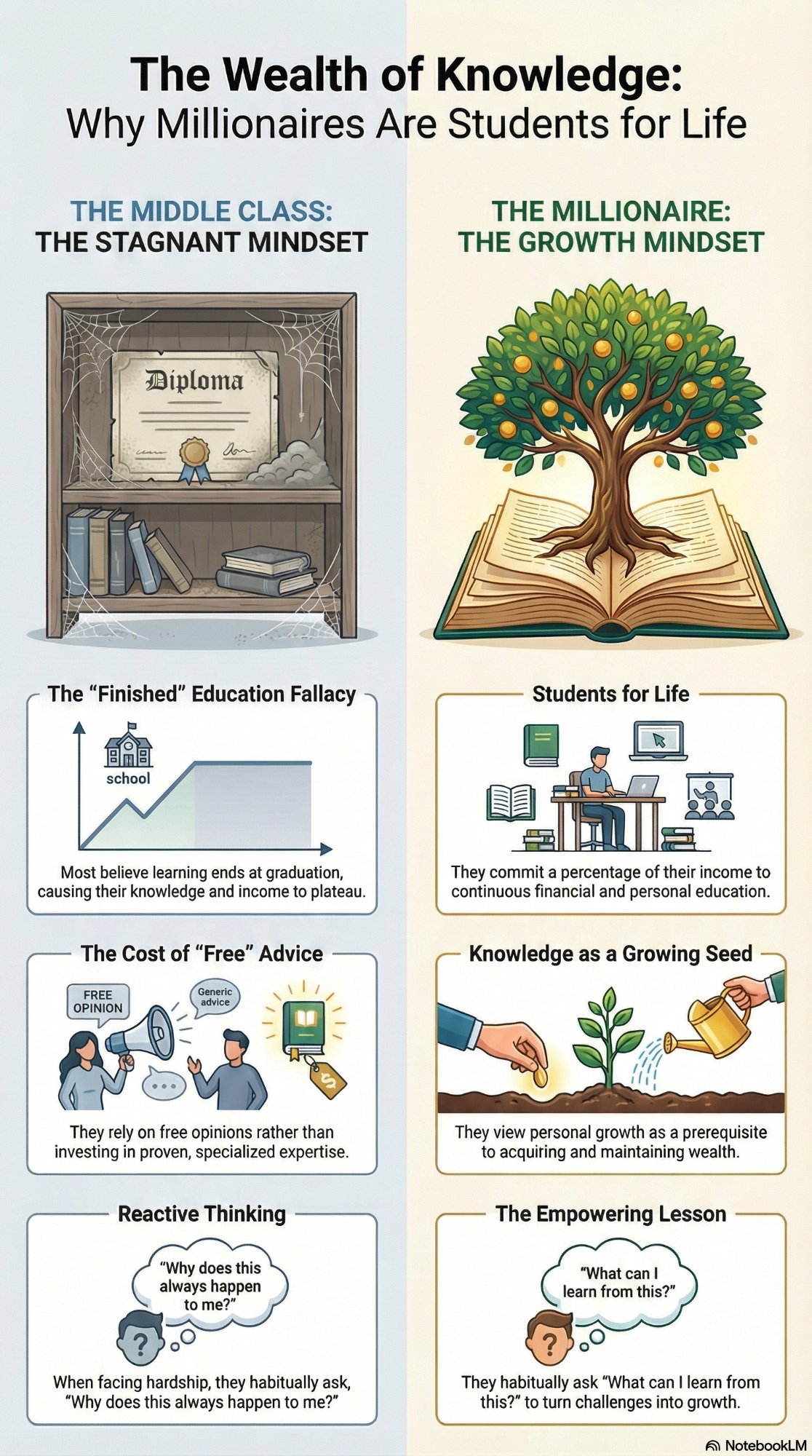
6. Millionaires Continually Learn and Grow. The Middle Class Thinks Learning Ended at School.
The middle class, Smith observes, tends to treat education as a phase that ends with a certificate. Millionaires treat it as a permanent condition. They read. They hire coaches with specialised knowledge. They spend money on education in the same spirit that they invest in assets — expecting a return. The returns, Smith argues, are larger and more reliable than almost any financial instrument.
His analysis of free advice is worth noting. The middle class, priced out of premium guidance, defaults to free advice — from friends, from comment sections, from people who think they know what they're talking about. Free advice, Smith warns, is often the most expensive advice, because it can misdirect years of effort. Millionaires pay for counsel from people who have achieved the specific thing they want to achieve.
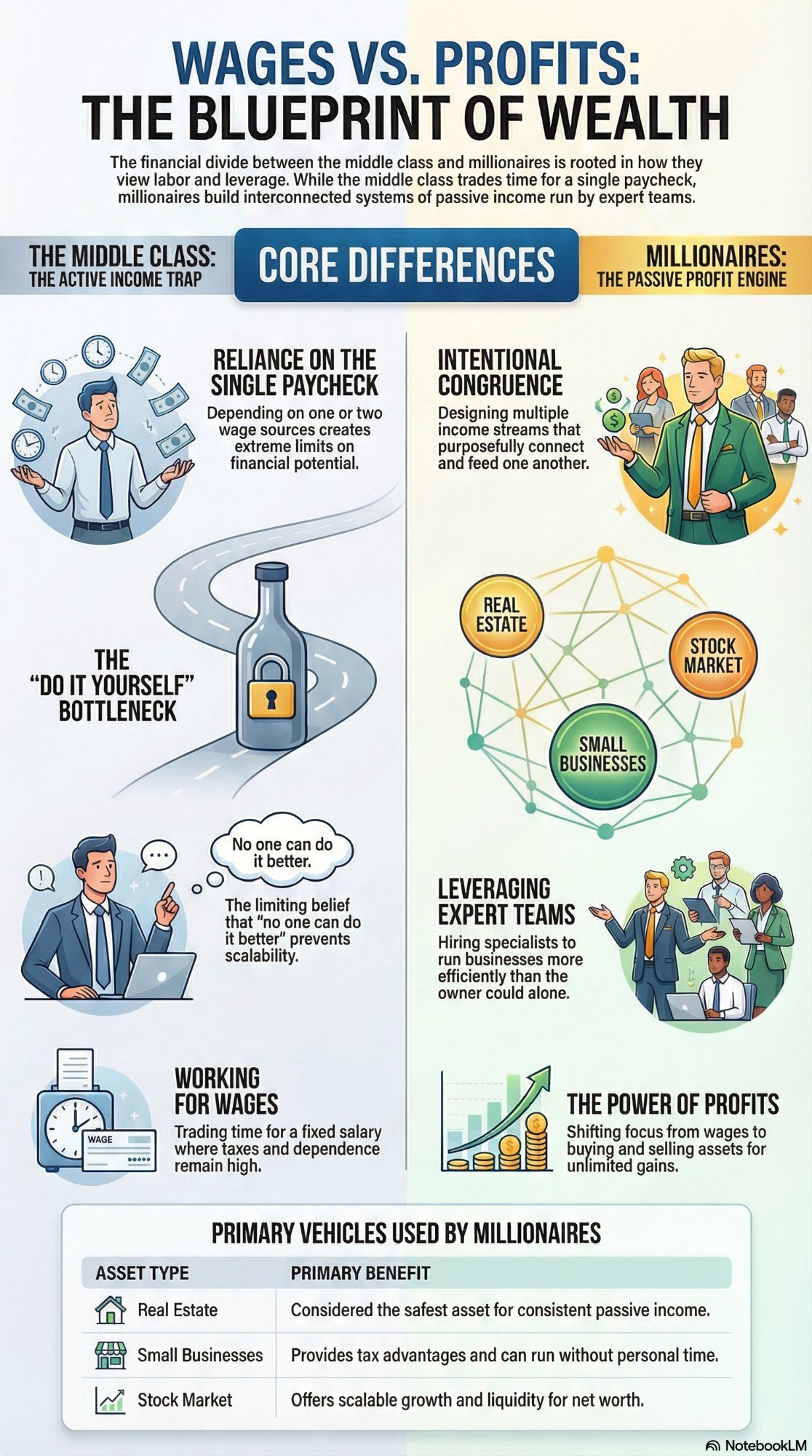
5. Millionaires Work for Profits. The Middle Class Works for Wages.
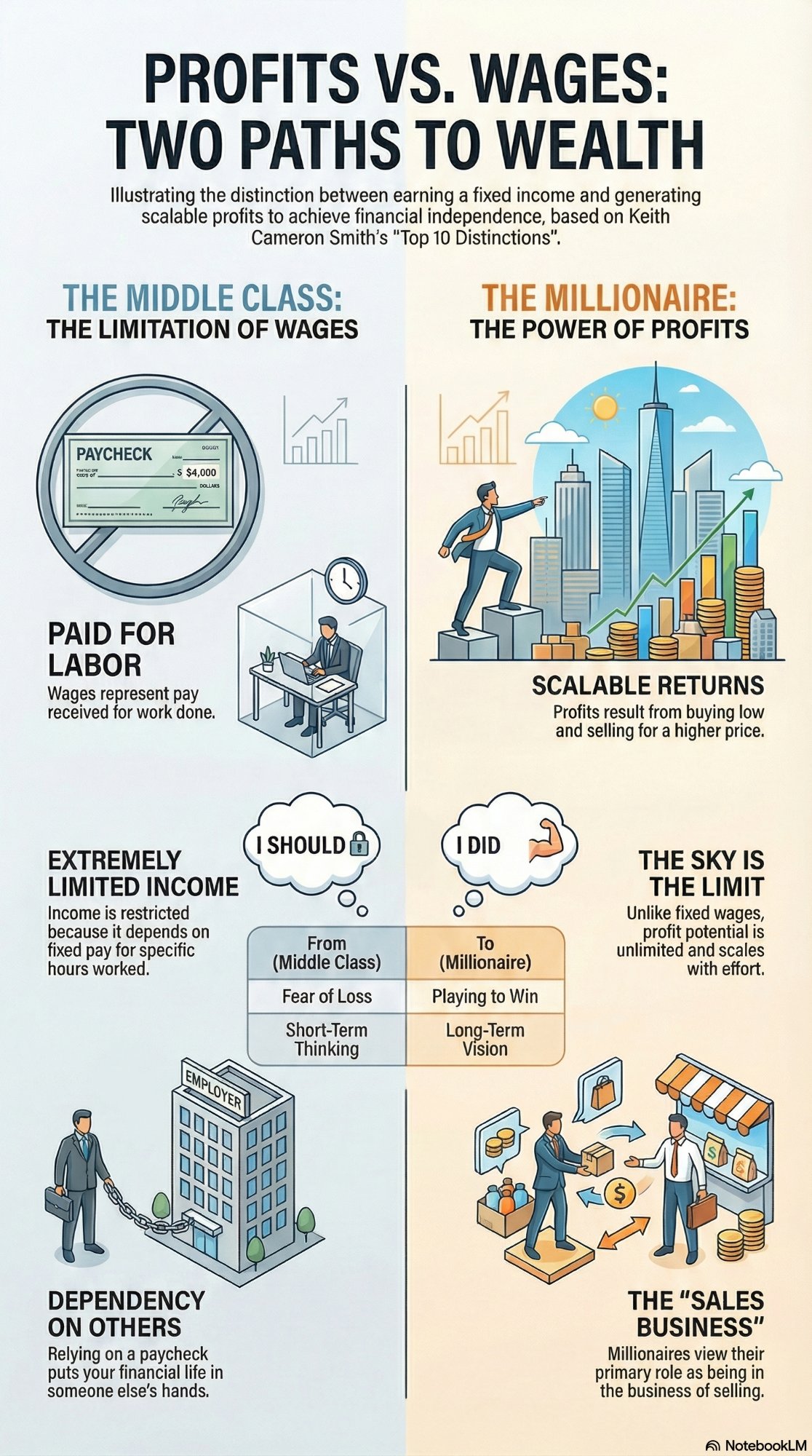
Wages, Smith explains, are the pay you receive for the work you do. Profits are the result of buying something for one price and selling it for more — and the spread between those two numbers has no ceiling. If you depend entirely on wages, your income is always capped by someone else's budget and someone else's willingness to keep you employed. If you learn to earn profits, you begin to control the variables.
This distinction does not require quitting employment; it requires developing, in parallel, an understanding of how profit works — and then building something, however small, that generates it.
4. Millionaires Believe They Must Be Generous. The Middle Class Believes It Cannot Afford to Give.
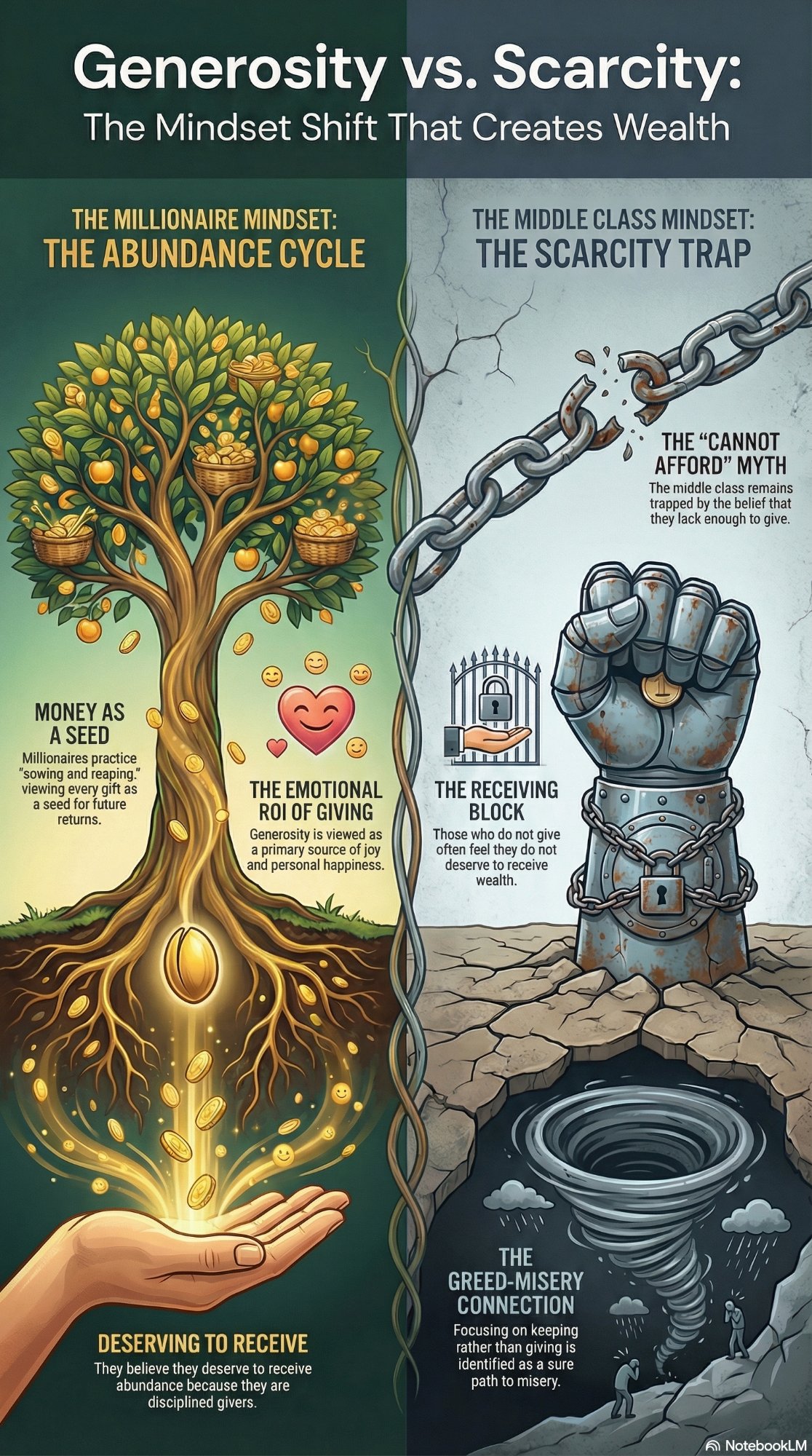
Smith's treatment of generosity is rooted in a deeply practical observation: people who give consistently tend to receive more, and people who hold tightly tend to contract. He frames generosity not as charity but as a form of abundance thinking — a demonstration, to yourself and the world, that you believe there is enough to go around. The middle class experiences scarcity as fact; millionaires experience it as a story they have the power to change.
Generosity, he also points out, works in both directions. Millionaires are not only good givers; they are also good receivers. They do not deflect compliments, turn down opportunities, or feel unworthy of help. The middle class, conditioned by scarcity, often finds receiving uncomfortable — and that discomfort blocks the very resources that could change their situation.
Chuck Feeney — The Billionaire Who Gave It All Away
Chuck Feeney co-founded the Duty Free Shoppers Group in 1960 and eventually accumulated a fortune estimated at several billion dollars. In 1984, in one of the most unusual acts of financial self-erasure in modern history, he secretly transferred nearly his entire stake in the business — worth roughly $500 million at the time — to a charitable foundation he had created, the Atlantic Philanthropies. Not even his business partners knew. He continued living in rented apartments, carrying documents in a plastic bag, flying economy class, and wearing a $10 Casio watch.
Over four decades, Feeney gave away more than $8 billion to universities, health systems, civil liberties organisations, and research institutions across Ireland, Vietnam, Australia, South Africa, and the United States. When Warren Buffett and Bill Gates launched the Giving Pledge in 2010, they cited Feeney as their model. Buffett said: "He is my hero and Bill Gates' hero. He should be everybody's hero." Feeney's own summary of his philosophy was simple: "I see little reason to delay giving when so much good can be achieved through supporting worthwhile causes." He spent his fortune completely and closed the Atlantic Philanthropies in 2020. He died in 2023 with assets of approximately $2 million.
3. Millionaires Have Multiple Sources of Income. The Middle Class Has Only One or Two.
The key to developing multiple income streams, Smith argues, is making them passive — income that does not require your direct, ongoing time to sustain. This is the hardest distinction to implement and the one most dependent on the others: it requires long-term thinking (distinction 10), idea generation (distinction 9), tolerance for risk (distinction 7), and continuous learning (distinction 6).
The concept Smith introduces here — intentional congruence — is particularly useful. Rather than building income streams that operate independently, millionaires construct them so that each one feeds and amplifies the others. A book leads to speaking engagements. Speaking engagements build a brand. A brand sells products. Products fund investments. The architecture is deliberate, not accidental.
2. Millionaires Focus on Increasing Their Net Worth. The Middle Class Focuses on Increasing Its Paycheck.
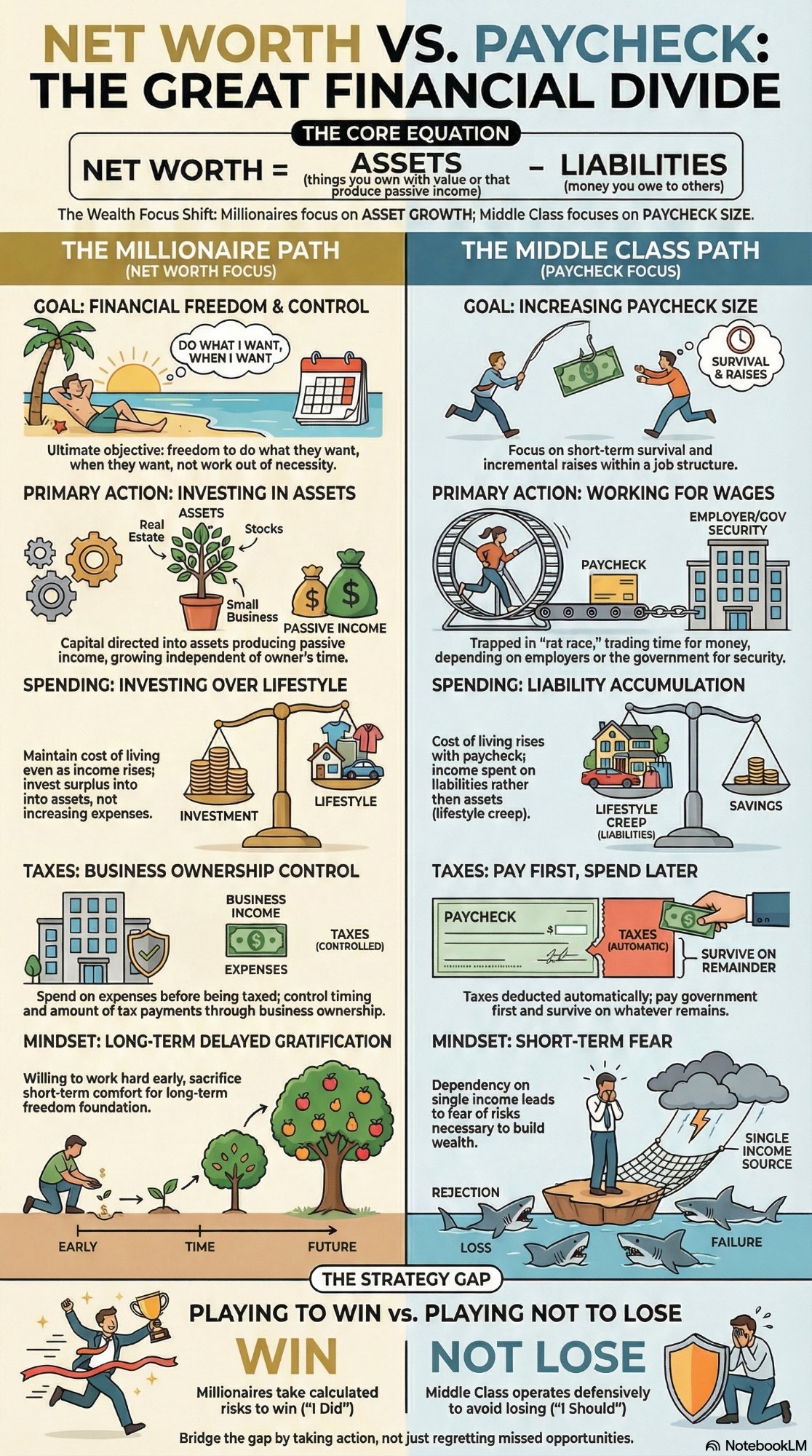
This distinction is structural. A bigger paycheck means bigger taxes and greater dependence on an employer. It is, in Smith's framing, a fundamentally fragile position — your income is controlled by someone else, your tax rate is determined by someone else, and your security evaporates the moment that relationship ends.
Net worth, by contrast, is built through assets: things you own that have value and generate passive income. The formula Smith describes is simple in concept and demanding in execution. Live at the same cost, regardless of income increases. Use income to buy assets rather than liabilities. Let those assets generate income. Reinvest that income. Over time, the compounding effect of this approach — not the scale of any individual paycheck — is what produces financial freedom.
He recommends that everyone, even those in salaried employment, run a small part-time business alongside their job. The goal is not instant replacement of income; it is the development of a second financial reality that is answerable to no one but the owner.
1. Millionaires Ask Themselves Empowering Questions. The Middle Class Asks Itself Disempowering Questions.
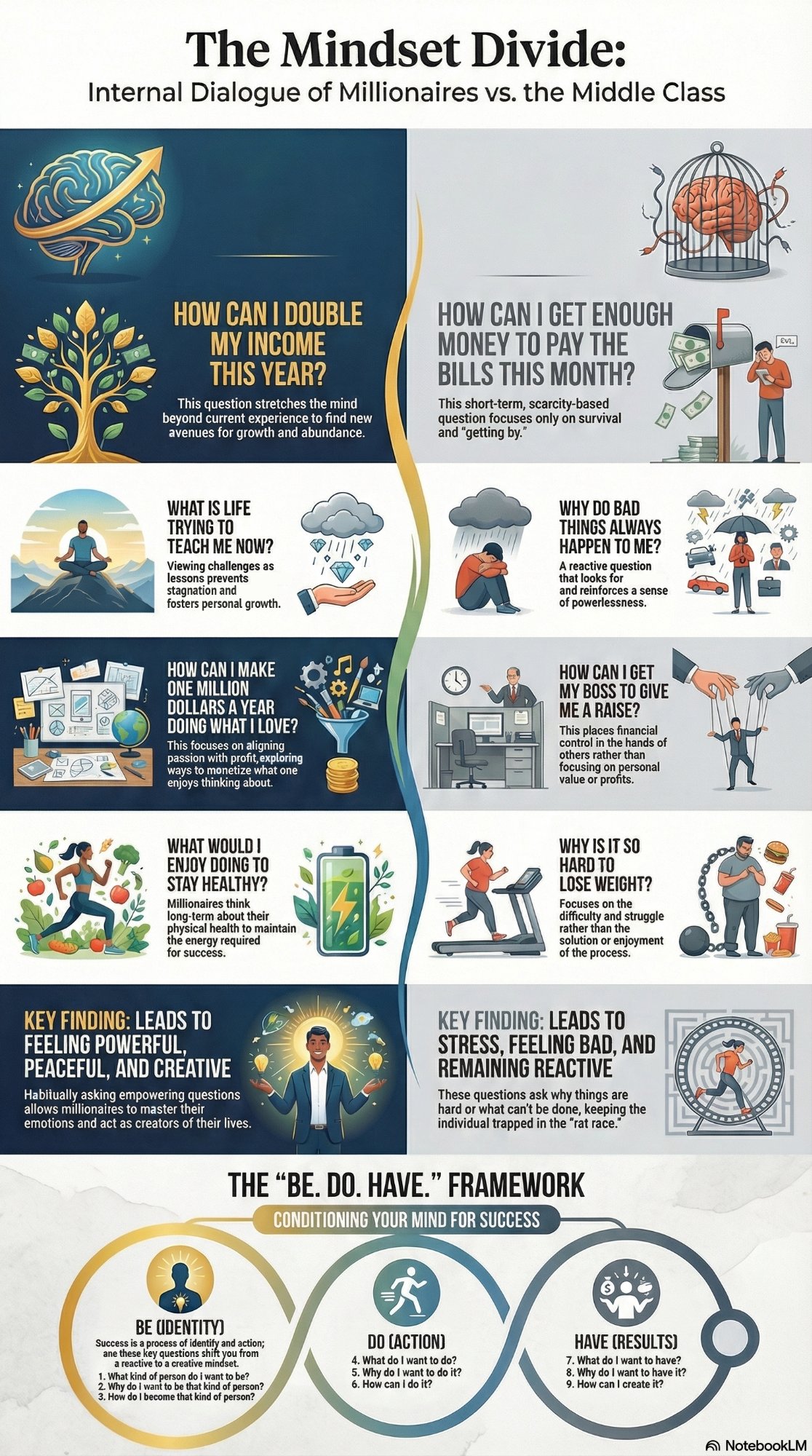
Smith places this distinction first because he believes it generates all the others. The questions you ask yourself — habitually, automatically, all day long — determine the direction of your thinking, the quality of your emotions, and ultimately the course of your life.
The middle class asks questions that confirm its limitations: Why does this always happen to me? Why is it so hard to save money? Why don't my kids appreciate me? These questions are not looking for answers. They are looking for evidence that the limitation is real. Millionaires ask questions that assume the problem is solvable: How can I double my income this year? What is life trying to teach me? How can I build a deeper relationship with the people I love? These questions do not guarantee results — but they open the mind to possibility rather than confirming impossibility.
Smith offers nine core empowering questions that map to three domains: being, doing, and having. What kind of person do you want to be? What do you want to do? What do you want to have? In each case, the second question is why, and the third is how. The sequence — be, do, have — is itself a reversal of middle-class thinking, which tends to approach the equation backwards: once I have enough, I will do what I want, and then I will become who I want to be. Smith argues that wealth flows in the other direction.
At a Glance
The Ten Distinctions, Summarised
Delayed gratification, patience, and decade-spanning goals vs. month-to-month survival thinking.
Ideas are the most valuable asset in the world. Talking about them regularly is how they multiply.
Confidence — built through preparation — transforms uncertainty from a threat into an opportunity.
Knowledge reduces fear. Calculated risk is not recklessness — it is preparation followed by action.
Every book, course, and mentor is a seed. Knowledge compounds just as capital does.
Wages are capped by someone else's budget. Profits are limited only by the value you create.
Generosity is an expression of abundance thinking — and it tends to return, multiplied.
Passive income, deliberate teams, and intentional congruence — streams that feed one another.
Assets that produce passive income, not salaries, are the engine of lasting financial freedom.
The questions you ask yourself determine the direction of your thinking — and ultimately, your life.
Final Word
Is the Book Worth Your Time?
The most common criticism of books in this category is that they are optimistic to the point of being untethered from the structural realities of economic life — that they assign personal responsibility for outcomes that are partly or substantially shaped by forces outside any individual's control. That criticism has merit, and it is worth holding in one hand while reading.
In the other hand, it is worth holding the following: the distinctions Smith describes are real. The people who demonstrate them — from Buffett's decades of patient compounding to Blakely's refusal to treat rejection as verdict to Feeney's radical demonstration that generosity is not a constraint but an amplifier — are not exceptions to the framework. They are the framework, embodied and proved.
Smith does not promise that adopting a millionaire's thinking will make every reader a millionaire. What he argues, more usefully, is that failing to examine these distinctions will make the alternative almost certain. The book's questions are worth sitting with regardless of whether you ever own a real estate portfolio or a business: What do you spend your time talking about? What questions do you ask yourself when things go wrong? Are you playing to win, or playing not to lose?
Those questions are free. The answers might not be comfortable. But they are the beginning of the only kind of change that Smith — or anyone else who has studied this territory carefully — believes is worth making.
Sources & Citations
- Keith Cameron Smith — Biography & career overview: wikipedia.org
- Smith — Book overview, praise, and publisher details: penguinrandomhouse.com
- Smith — Goodreads author profile, reader reviews: goodreads.com
- Warren Buffett — Long-term thinking, GEICO investment, early life lessons: newtraderu.com
- Warren Buffett — Delayed gratification and philanthropic strategy: selfemployed.com
- Warren Buffett — Comments on delayed gratification at Berkshire AGM: qz.com
- Sara Blakely — Stanford GSB profile (founding story, ideas philosophy): gsb.stanford.edu
- Sara Blakely — Virgin profile (risk-taking, LSAT, writing ideas down): virgin.com
- Sara Blakely — Wikipedia biography (Spanx timeline, Blackstone deal): wikipedia.org
- Sara Blakely — Founding story and bootstrapped growth: talkroute.com
- Chuck Feeney — Atlantic Philanthropies obituary and legacy overview: atlanticphilanthropies.org
- Chuck Feeney — Wikipedia biography (DFS, secret giving, Giving Pledge): wikipedia.org
- Chuck Feeney — Forbes / General Atlantic profile ("The Billionaire Who Wanted to Die Broke"): generalatlantic.com
- Chuck Feeney — Cornell Chronicle obituary: news.cornell.edu
Based on notes from The Top 10 Distinctions Between Millionaires and the Middle Class by Keith Cameron Smith (Ballantine Books, 2007). All external sources linked and cited above.